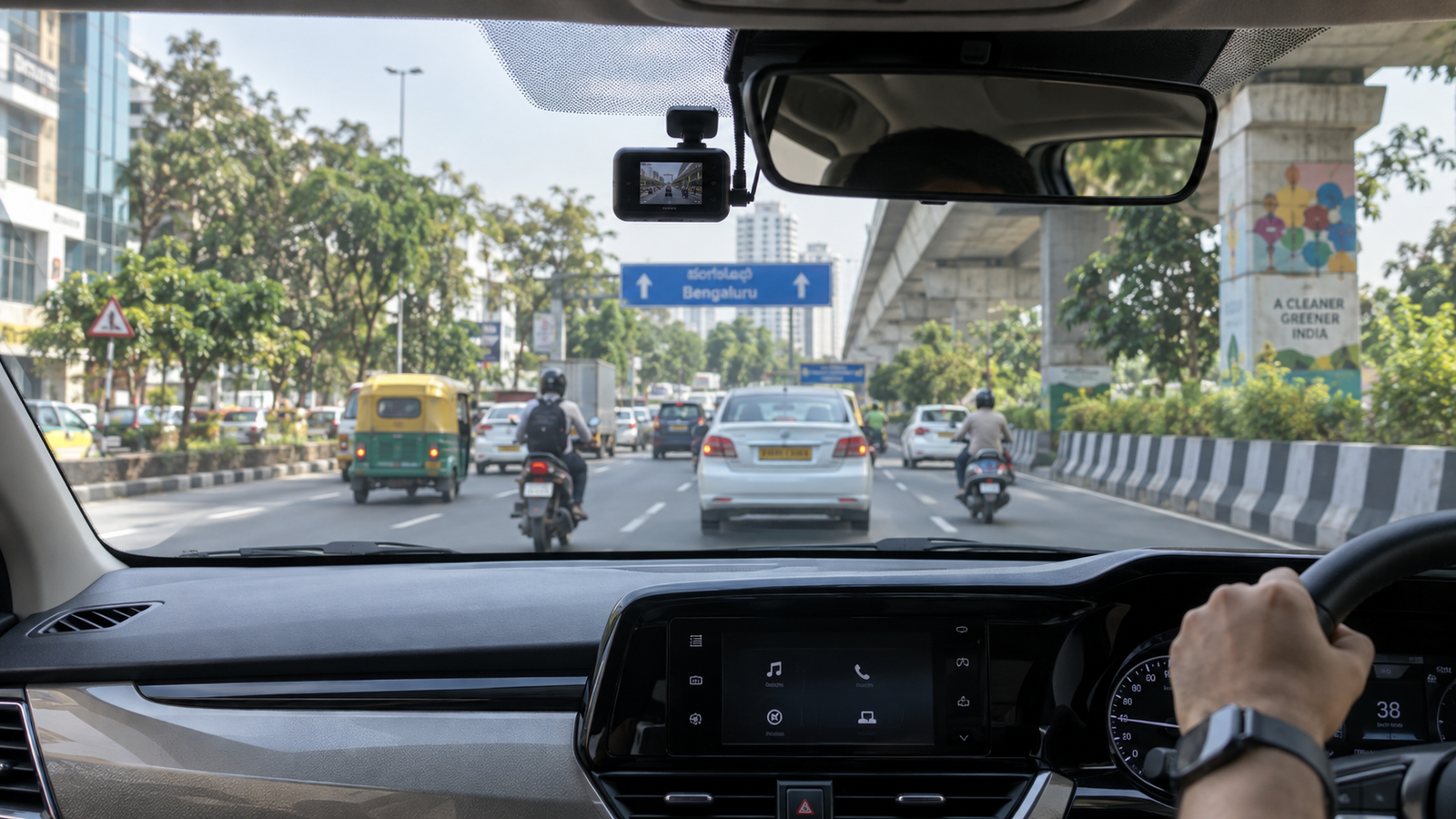
The Car Accessory More Indian Drivers Are Deciding They Need
8 September 2026 · Media Pitch Product Expert
A dash cam cannot prevent an accident, but it can record what happened. Here is what Indian drivers should check before buying one.
★★★★★
Best for: Daily commuters, highway drivers, new-car
owners and anyone who wants an independent video record of what happened on the
road
Why this category stands out: A dash
cam solves an unusually clear problem: when two people remember an incident
differently, video may provide useful documentation.
Affiliate Disclosure: This article contains affiliate links. If you purchase through one of these links, we may earn a commission at no additional cost to you. As an Amazon Associate, we earn from qualifying purchases.
You probably hope you will never need the most important recording your dash cam makes.
For hundreds of ordinary journeys, it may simply sit behind the windscreen, automatically recording the road ahead and replacing old footage as its storage fills.
Then something happens.
A vehicle cuts across your lane. Someone reverses into your parked car. There is disagreement about who changed lanes first. Or something unusual happens on the highway and, instead of relying entirely on memory, you have a recording.
That simple proposition helps explain why dash cams are becoming a much more interesting car-accessory category in India.
One industry estimate values India's automotive dashboard-camera market at about US$154.8 million in 2026 and projects substantial expansion through 2032. Treat that as a market-research forecast rather than an official sales count, but the direction is notable.
The potential audience is also getting larger: SIAM reports that passenger-vehicle sales reached a record 46.43 lakh units in FY2025–26, up 7.9% year on year.
But does every Indian driver actually need a dash cam?
Not necessarily.
For many drivers, though, it is becoming one of the more sensible accessories to consider.
What Does a Dash Cam Actually Do?
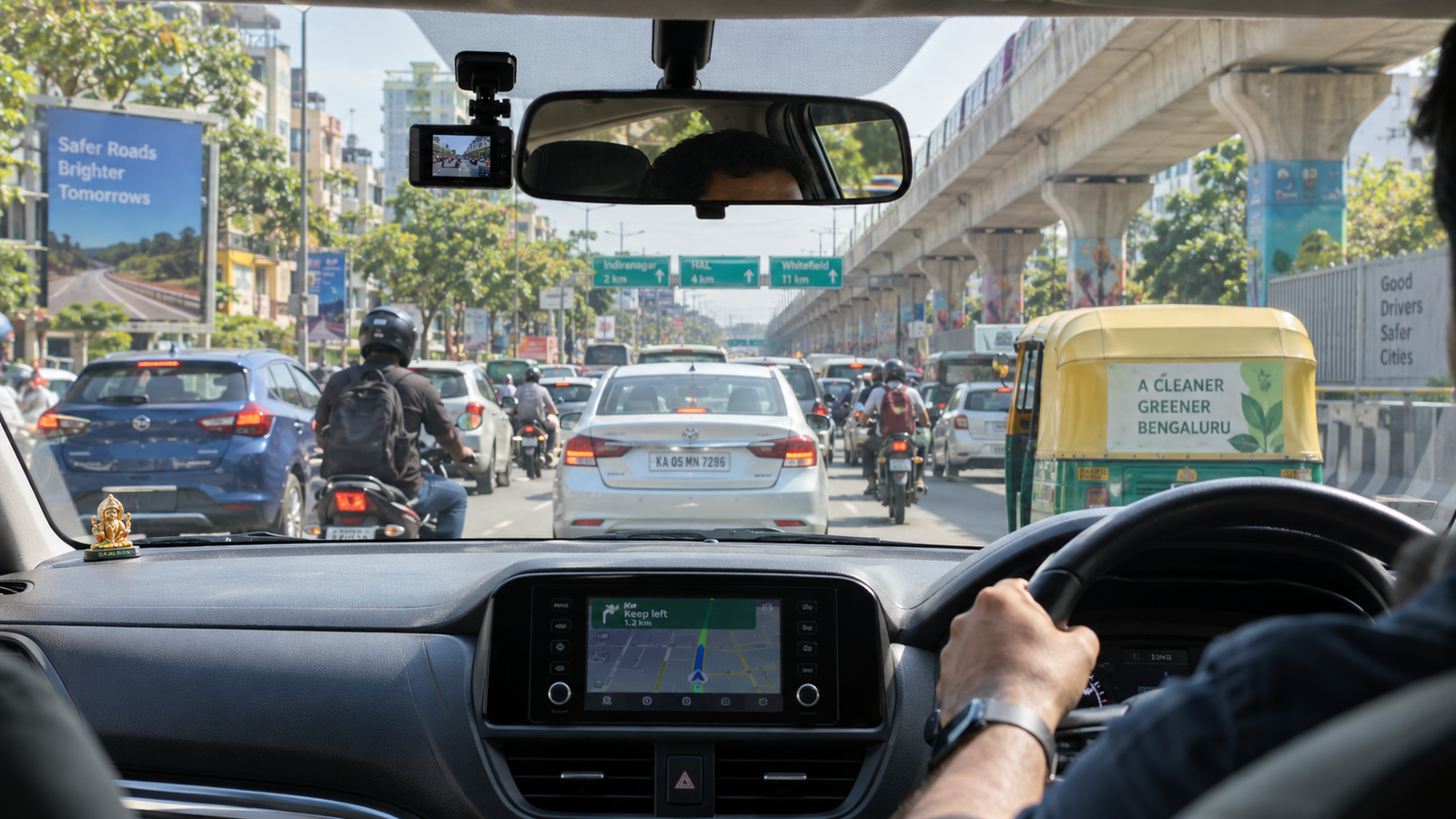
A dash cam is a compact camera mounted inside your vehicle, normally near the windscreen.
When the car is running, it records video of the road.
Most modern models use loop recording: once the memory card fills, the oldest ordinary recordings are overwritten by new ones. Current dash cams from major manufacturers also commonly offer features such as event locking, phone connectivity, GPS, rear cameras and parking surveillance, although the exact combination varies by model.
That means you don't normally need to remember to press “record” every morning.
The entire point is that the camera is already recording before you know something important is about to happen.
Why Dash Cams Make Particular Sense on Indian Roads
Driving conditions can change very quickly.
A normal journey can include cars, buses, bikes, pedestrians, cyclists, autos, delivery riders, animals, roadworks and vehicles entering from side roads—all within a relatively small space.
A dash cam cannot prevent an accident.
It cannot improve somebody else's driving.
And installing one should certainly not make you drive more aggressively because “everything is being recorded.”
What it can give you is something much simpler:
A contemporaneous video record.
That distinction matters.
Instead of trying to remember whether another vehicle crossed into your lane three seconds before impact, you may be able to review the footage.
Instead of arguing about whether a car was already damaged when you returned to it, parking surveillance may sometimes capture an incident—provided the particular camera supports the feature and has been installed correctly.
That is a very understandable reason to buy one.
Is Dash-Cam Footage Useful After an Accident?
Potentially, yes—but don't interpret “I have video” as “I automatically win any dispute.”
India's Bharatiya Sakshya Adhiniyam, 2023, which has been in force since July 2024, recognises electronic and digital records within the evidence framework. Section 61 says electronic or digital records are not to be denied admissibility merely because they are electronic, while Section 63 sets conditions concerning electronic records.
So dash-cam footage may be useful documentation, but questions of admissibility, authenticity and evidentiary weight depend on the circumstances.
A sensible habit after a significant incident is therefore to:
- preserve the original recording;
- avoid repeatedly editing or recompressing it;
- save a backup;
- note the date and circumstances;
- follow any instructions given by police, insurers or legal advisers.
Think of a dash cam as potential evidence and documentation, not your own miniature judge.
Front-Only or Front-and-Rear Dash Cam?
This is probably the first major buying decision.
Front-only dash cam
A single-channel camera records what happens ahead of your vehicle.
Best for:
- buyers on a tighter budget;
- people who mainly want accident documentation;
- simple installations;
- drivers who want to test whether they find a dash cam useful.
A good front camera can still cover many common road incidents.
Front-and-rear dash cam
A dual-channel system adds another camera facing behind the car.
Modern dual-channel models commonly record the two camera feeds separately.
Best for:
- frequent highway drivers;
- cars that spend significant time in dense traffic;
- buyers concerned about rear impacts;
- drivers who want wider incident coverage.
For many buyers purchasing their first serious dash cam, front + rear is the configuration I would investigate first.
It costs more and installation is more involved, but the additional viewpoint can be genuinely useful.
1080p, 2K or 4K: How Much Resolution Do You Need?
Amazon listings can quickly turn dash-cam shopping into a resolution contest.
FULL HD! 2K! 3K! 4K!
Higher resolution can preserve more image detail, but the biggest number on the box does not automatically produce the best real-world footage.
A dash cam also has to cope with:
- movement;
- vibration;
- shadows;
- headlights;
- low light;
- glare;
- number plates travelling at different speeds;
- bright Indian sunshine;
- sudden transitions between light and shade.
Current premium models offer 4K front recording, while more affordable models commonly use 1080p, 2K or 3K resolutions.
My practical rule
1080p: Acceptable starting point if budget is the priority.
2K/3K: Often a sensible middle ground for buyers wanting additional detail without automatically stepping into premium pricing.
4K: Worth considering when footage detail is a high priority, particularly on the front camera—but compare actual image quality rather than resolution alone.
Look for independent sample footage if possible.
Night Recording Matters More Than the Specification Sheet Suggests
A dash cam that looks superb at noon may behave very differently at 10 p.m.
Night driving introduces:
- bright headlights;
- dark road edges;
- illuminated number plates;
- streetlights;
- reflections from the windscreen;
- rapidly changing exposure.
That makes HDR, sensor quality, lens characteristics and image processing worth examining alongside raw resolution.
Several current dual-camera systems specifically promote HDR or enhanced night-recording modes, reflecting how important low-light performance has become within the category.
Don't assume the words “night vision” guarantee excellent results.
Look at actual night samples.
Parking Mode Sounds Brilliant—But Read the Small Print
Parking surveillance is one of the most attractive dash-cam features.
Imagine returning to your car and finding a new scrape.
A parking-capable dash cam may be able to record certain events while the ignition is off.
But this is also one of the easiest features to misunderstand.
Many dash cams require additional hardware
For example, Qubo states that parking mode on one of its current dual-channel systems requires a compatible hardwiring kit. 70mai likewise states that certain parking-surveillance functions require a separately sold hardwire kit.
DDPAI makes similar requirements on several models.
So before buying because the listing says “24-hour parking monitoring,” check:
- Is the necessary hardwire kit included?
- Is professional installation recommended?
- Does the system provide low-voltage protection for the vehicle battery?
- What exactly triggers recording?
- Is recording continuous, time-lapse or event-based?
The ₹ price on the dash cam may not represent the complete installed cost.
The Memory Card Is More Important Than It Looks
Your dash cam may spend hours writing video every day.
That is a very different workload from occasionally saving photographs to a memory card.
Check:
- maximum supported card capacity;
- minimum speed/class requirements;
- whether the manufacturer recommends high-endurance cards;
- whether a card is included;
- how frequently the card should be formatted or checked.
Current devices vary considerably: some support cards up to 256GB, while premium models may accept 512GB and may include internal storage as well.
Don't simply buy the largest card you find.
Confirm compatibility first.
Loop Recording: The Feature You Don't Want to Think About
Without loop recording, you would eventually fill the card and have to delete video manually.
With it, the camera automatically replaces older ordinary recordings.
For example, Qubo and 70mai both describe loop-recording systems that overwrite older footage when storage fills.
However, important event clips may be handled differently.
Check how your chosen model protects or “locks” emergency footage—and periodically inspect storage rather than assuming everything is working indefinitely.
Do You Need GPS?
Built-in GPS can add useful information such as journey location and, depending on the system, speed data.
Whether you need it depends on why you're buying the camera.
GPS may be useful for:
- documenting where an event occurred;
- reviewing journeys;
- fleet/business use;
- adding additional context to recorded footage.
But GPS isn't essential to the fundamental job of recording video.
If the choice is between:
better core camera performance
and
weaker video plus lots of extras,
I would prioritise the video.
Do You Need Wi-Fi and an App?
This feature is more useful than it initially sounds.
Without wireless connectivity, retrieving footage may involve removing the memory card and inserting it into another device.
With Wi-Fi, many current dash cams allow you to connect a phone directly to the camera to preview and download recordings.
That can be extremely convenient if you want to retrieve a clip immediately after an incident.
Before buying, however, check reviews of the app, not merely the camera.
A brilliant camera paired with unreliable software can become frustrating.
What Is a G-Sensor?
Many dash cams contain an accelerometer—usually described as a G-sensor.
It detects sudden movement or impact.
Depending on the model and settings, this can trigger the camera to protect the relevant recording from being immediately overwritten.
That can be useful.
But excessively sensitive settings can also result in many clips being locked by potholes or hard braking.
Treat it as a useful supporting feature, not a substitute for checking and saving important video yourself.
Supercapacitor vs Battery: An Important Indian-Climate Consideration
Cars become extremely hot when parked in direct sunlight.
For that reason, I would pay attention to a dash cam's stated operating-temperature range and power design.
Many current dash cams use supercapacitors, and manufacturers market them specifically around temperature tolerance and long-term in-car reliability.
That does not mean every supercapacitor model is automatically superior to every battery-powered camera.
But in India, where a car interior can experience substantial heat, thermal specifications deserve considerably more attention than decorative features.
Don't Let ADAS Sell You the Dash Cam
Some dash cams advertise driver-assistance functions such as:
- lane-departure warnings;
- forward-vehicle alerts;
- vehicle-start alerts;
- fatigue warnings.
These can sound impressive.
But a windscreen-mounted aftermarket camera should not automatically be treated like a vehicle manufacturer's integrated safety system.
I would regard ADAS-type features as extras, not the primary reason to choose a dash cam.
The priority order should be closer to:
video quality → reliability → storage → installation → front/rear coverage → useful connectivity → extras.
Does Field of View Matter?
Yes, but wider is not automatically better.
A wide-angle lens captures more of what is happening around the vehicle.
Current models often sit around the 140-degree range, although specifications vary.
Go excessively wide, however, and objects can appear smaller or more distorted.
The goal is useful road coverage, not simply the largest field-of-view number.
Where Should a Dash Cam Be Installed?
Ideally, it should have a clear view of the road without creating a distracting obstruction for the driver.
Many owners position compact cameras high on the windscreen, around the rear-view-mirror area, depending on vehicle layout.
Installation quality matters because:
- cables should not dangle across your view;
- the camera should not interfere with driving;
- rear-camera cables need sensible routing;
- airbag deployment areas should remain unobstructed;
- hardwiring should be done properly.
If you're uncomfortable removing trim panels or working with vehicle wiring, paying for proper installation can be worthwhile.
Are Dash Cams Legal in India?
This subject deserves careful wording.
India's road-safety regulations explicitly recognise dashboard cameras as a form of electronic enforcement device in the context of authorised government traffic enforcement.
I did not find, in the official material reviewed for this article, a blanket nationwide prohibition on ordinary private motorists using a forward-facing dash cam.
However, recording, storing, sharing and publishing footage can raise different privacy and data issues depending on the circumstances. India now has a statutory digital-personal-data framework under the Digital Personal Data Protection Act and the 2025 Rules.
So distinguish between:
recording an incident for legitimate documentation
and
uploading identifiable footage of strangers publicly for entertainment.
They are not necessarily the same legal or privacy question.
If footage concerns a serious accident, criminal allegation or other legal dispute, obtain appropriate professional advice rather than relying on an Amazon buying guide.
Eight Things I'd Check Before Buying a Dash Cam
1. Front or dual channel
Choose how much coverage you need before comparing flashy specifications.
2. Actual video quality
Resolution matters, but sample footage matters more.
Check daytime and nighttime recordings.
3. Storage support
Make sure compatible memory cards are affordable and readily available.
4. Loop recording
This should be straightforward and reliable.
5. Heat tolerance
Especially important for cars routinely parked outdoors in India.
6. Parking surveillance
Find out whether it requires an additional hardwire kit.
7. App experience
If Wi-Fi transfer is important to you, app quality is part of the product.
8. Installation
Include cables, hardwire kits, rear-camera fitting and professional installation when calculating the real cost.
Who Should Seriously Consider a Dash Cam?
Daily city commuters
More time on busy roads means more opportunities for incidents that may be difficult to reconstruct afterwards.
Highway drivers
Long-distance journeys create an especially strong case for continuously recording the road.
New-car owners
If you have just spent several lakh rupees on a vehicle, spending a comparatively small amount on incident documentation may make sense.
Cars frequently parked in public places
A properly configured parking-surveillance system may add value here.
Commercial and fleet drivers
Recording and location information can have additional operational value, though commercial users should consider relevant workplace, privacy and company policies.
Families lending the same car to several drivers
Footage can provide useful context if something happens when another family member is driving.
Who Might Not Need One?
A dash cam isn't compulsory just because you own a car.
You might reasonably skip one if:
- you drive extremely infrequently;
- the car rarely leaves a controlled environment;
- you don't want another device and cables in the cabin;
- you are unwilling to check storage and maintain it;
- the cost outweighs the benefit for your use.
A cheap dash cam that has stopped recording because its memory card failed isn't much protection.
Buying one means accepting a small amount of maintenance.
The Biggest Dash-Cam Buying Mistake
It is probably this:
Buying purely by resolution.
A listing says 4K, so it must be better than everything labelled 2K.
Not necessarily.
I would rather have a reliable dash cam that:
- starts recording every time;
- produces usable footage at night;
- survives the environment inside the car;
- reliably saves incident clips;
- has a good app;
- supports readily available storage;
than an inexpensive camera whose main selling point is an enormous resolution badge.
Dash cams are documentation devices.
Reliability is a feature.
Why We Give Dash Cams ★★★★★
The five-star rating isn't because every driver must rush out and buy one.
It is because dash cams score exceptionally well as a problem-solving product category.
They have:
- a clear use case;
- meaningful differences between models;
- options at multiple budgets;
- straightforward upgrade paths;
- strong buyer intent;
- a potentially valuable role when something goes wrong.
The category is also developing quickly. Current systems span simple front-facing cameras through dual-channel 4K units with GPS, Wi-Fi, parking surveillance and even connected 4G features.
That makes this exactly the sort of Amazon category where buyers benefit from understanding the features before choosing a product.
The Verdict: Do Indian Drivers Need a Dash Cam?
For many drivers, the case is becoming increasingly persuasive.
A dash cam won't make another driver stop cutting across lanes.
It won't prevent somebody from reversing into your car.
And it won't guarantee how a dispute will be resolved.
What it can do is provide something you otherwise may not have:
a recording of what actually happened.
For regular commuters and highway drivers in particular, that can make a dash cam one of the more rational car accessories to consider.
If you're shopping for one, start with:
front vs dual channel → footage quality → reliability → storage → heat tolerance → parking requirements.
Everything else is secondary.
Amazon prices, specifications, accessories and availability can change. Check the current listing, manufacturer information and installation requirements before purchasing.
Frequently Asked Questions
Is a dash cam worth buying in India?
For drivers who spend significant time on busy roads or highways, a dash cam can be worthwhile because it creates a video record of journeys and may provide useful documentation after an incident.
Should I buy a front-only or front-and-rear dash cam?
A front camera is the simpler and less expensive choice. A front-and-rear system offers wider incident coverage and may be more appropriate for frequent drivers.
Is 1080p enough for a dash cam?
1080p can be adequate for basic recording, but 2K, 3K and 4K models can preserve more detail. Resolution alone does not determine image quality, particularly at night.
Is 4K worth paying extra for?
Potentially, particularly if identifying fine detail is important. Compare real sample footage, night performance, sensor quality and reliability rather than choosing purely from the 4K label.
Does a dash cam record when the car is switched off?
Some models offer parking surveillance, but this often requires an additional hardwire kit or power accessory. Always check the requirements of the specific model.
Does a dash cam need a memory card?
Many models use microSD cards, although supported capacities vary and some premium cameras also include built-in storage. Check the manufacturer's card requirements before purchasing.
What happens when dash-cam storage becomes full?
Models with loop recording overwrite older ordinary footage with newer recordings. Important event recordings may be locked separately depending on the model.
Can dash-cam footage be used as evidence in India?
Electronic and digital records are recognised under the Bharatiya Sakshya Adhiniyam, subject to its requirements. Whether particular dash-cam footage is admissible or how much evidentiary weight it receives depends on the circumstances.