
Educational Toys Children Might Actually Choose Over Another Screen
5 September 2026 · Media Pitch Product Expert
Looking for screen-free activities children will actually enjoy? Explore educational and STEM toy ideas that combine play, creativity and learning.
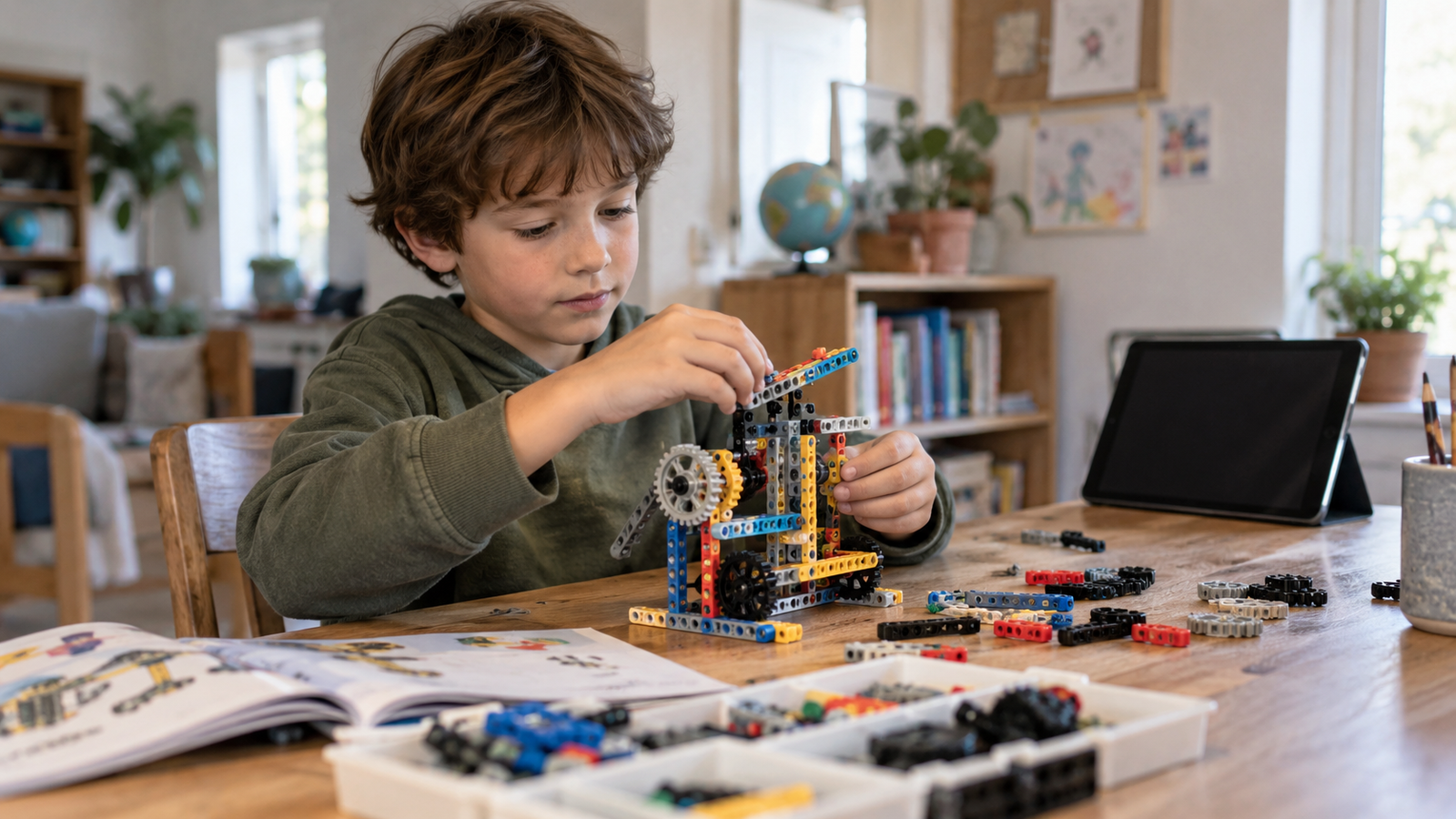
There is nothing particularly unusual about a child choosing a tablet, television or phone over a box labelled “educational.”
Screens are colourful, responsive and instantly entertaining. Many educational toys, by comparison, are bought with good intentions and then quietly disappear into a cupboard after a few days.
So the real question for parents is not simply:
“Which toys help children learn?”
It is:
“Which educational toys are interesting enough that children will actually want to play with them?”
The best screen-free toys tend to combine learning with something children already enjoy doing—building, experimenting, pretending, solving mysteries, creating art or making things move.
That distinction matters.
A toy does not need to feel like homework to be educational.
In fact, some of the most useful STEM and learning toys work precisely because the child is focused on the activity rather than on the lesson hidden inside it.
Here are the types of educational toys worth considering if you want more screen-free play without making children feel that their free time has turned into another class.
Why Screen-Free Play Still Matters
Screens are part of modern childhood, and trying to eliminate them completely is neither realistic nor necessarily useful.
The better goal is balance.
Children also benefit from activities that encourage them to:
- build things with their hands
- solve problems independently
- experiment and make mistakes
- use their imagination
- concentrate on one activity
- interact with other children
- create something rather than simply consume entertainment
Good educational toys can support several of these skills at the same time.
The challenge is choosing toys that generate genuine curiosity.
1. Building and Construction Sets
Few educational toys have as much repeat-play potential as a good construction set.
Children can build a structure, dismantle it and start again.
That simple loop encourages experimentation.
Depending on the set, children may explore ideas involving:
- balance
- shape
- symmetry
- measurement
- structural stability
- spatial reasoning
- creative problem-solving
The important feature here is open-ended play.
A kit that can produce dozens of different creations may remain interesting considerably longer than one that has a single predetermined outcome.
Why children may choose it over a screen
Building gives children immediate feedback.
If a tower falls, they try another design.
If a vehicle does not move as expected, they change it.
There is a satisfying challenge-and-reward cycle without needing a digital game.
Best for
Children who enjoy:
- LEGO-style play
- construction
- vehicles
- engineering
- creating their own designs
What parents should look for
Check:
- recommended age
- piece size
- number of components
- complexity
- storage requirements
- whether the toy allows free building after the guided projects are finished
A construction set that remains useful after the instruction booklet has been completed generally offers more long-term play value.
2. Science Experiment Kits
Science kits can turn subjects children encounter in textbooks into something they can actually see and manipulate.
Depending on the kit, activities might explore areas such as:
- chemistry
- electricity
- magnets
- light
- plants
- weather
- crystals
- mechanics
The appeal is obvious.
Reading about a scientific idea is one thing.
Making something fizz, move, grow or change colour is another.
Why children may choose it over a screen
Experiments create anticipation.
Children want to know:
“What happens if I do this?”
That curiosity can be more engaging than simply telling a child that an activity is educational.
Best for
Children who constantly ask:
- Why?
- How?
- What happens if…?
What parents should look for
Consider:
- whether adult supervision is required
- how many experiments are included
- whether consumable materials need replacement
- the clarity of the instructions
- suitability for the child's age
A kit containing 30 activities is not automatically better than one containing 10. Well-designed experiments that children can understand and repeat may provide greater value.
3. Beginner Robotics Kits
Robotics can be one of the easiest ways to make STEM feel exciting rather than academic.
Instead of learning abstract concepts on their own, children can see how different ideas work together.
A robotics activity may introduce:
- engineering
- mechanics
- electronics
- sequencing
- logical thinking
- coding concepts
- problem-solving
Some beginner kits are primarily mechanical, while others incorporate electronic controls or programming.
Why children may choose it over a screen
Because they eventually get to say:
“I built that.”
A moving robot provides a highly visible reward for the work involved.
For many children, getting a machine to follow a command or complete an action turns the learning process into a challenge.
Best for
Children interested in:
- robots
- gadgets
- machines
- coding
- engineering
A useful buying distinction
Not all robotics kits are genuinely screen-free.
Some require a phone, tablet or computer for programming.
That is not necessarily a disadvantage—the screen is being used as a creative tool rather than purely for passive entertainment—but parents specifically looking for completely screen-free activities should check before buying.
4. Magnetic Building Tiles
Magnetic construction toys are popular for a good reason: they are simple to understand but difficult to exhaust creatively.
Children can use geometric pieces to make:
- houses
- towers
- vehicles
- animals
- patterns
- geometric forms
- imaginary structures
They can also provide a hands-on introduction to concepts involving shape and spatial reasoning.
Why children may keep returning to them
There is no single correct finished result.
That gives children ownership of the activity.
One day the pieces might become a castle.
The next day they might become a rocket.
That repeatability is particularly valuable when comparing toys as gifts.
Best for
Children who enjoy creative construction but may find traditional building systems too complicated.
Before buying
Check the manufacturer's age recommendation and consider the size and construction of the pieces, especially when younger siblings are present.
5. Marble Runs
A marble run looks like a toy.
What children are actually doing is repeatedly experimenting with cause and effect.
They build a route, release the marble and see what happens.
When something fails, they modify the design.
That can introduce ideas related to:
- gravity
- motion
- speed
- slopes
- momentum
- sequencing
- construction
without needing a formal science lesson.
Why it competes well with screens
It offers movement.
Static educational toys can sometimes struggle to hold attention, while watching a marble race through a course creates an immediate reward.
Children often want to rebuild the track simply to see whether the next version works better.
Best for
Children who enjoy puzzles, construction and moving objects.
6. Circuit and Electronics Kits
Circuit kits can introduce children to electricity without beginning with complicated theoretical explanations.
Depending on the system, children may connect components to create:
- lights
- alarms
- fans
- motors
- switches
- simple electronic projects
This turns electricity into something visible and interactive.
Why children find them satisfying
The result is immediate.
Connect something correctly and a light turns on.
Change the circuit and something different happens.
That instant feedback creates a natural incentive to experiment.
Best for
Older children with an interest in:
- electronics
- gadgets
- engineering
- how machines work
What to check
Pay attention to:
- age recommendation
- safety information
- supervision requirements
- project difficulty
- replacement components
- instructions
For a beginner, a system that clearly explains why each project works may be more educational than one that simply provides assembly diagrams.
7. Mechanical Engineering Kits
Gears, pulleys, levers, wheels, axles and linkages are much more interesting when children can use them to build something.
Mechanical engineering kits can help children understand how movement is transferred from one part of a machine to another.
Depending on the product, children might build:
- vehicles
- cranes
- machines
- bridges
- mechanisms
Why they are engaging
Many children love discovering how things work.
A mechanical kit gives them permission to experiment.
It can also encourage persistence because designs do not always work correctly the first time.
Failure becomes part of the game.
8. Puzzle and Logic Games
STEM does not have to involve wires, robots or laboratories.
Logic games can be equally valuable.
These may involve:
- pattern recognition
- sequencing
- spatial problems
- mazes
- strategy
- deduction
- mathematical thinking
The strongest ones present the learning as a challenge:
Can you solve this?
Why children might prefer them to another video
Good puzzle games create the same desire to “beat the next level” that makes many digital games compelling.
The difference is that the challenge exists physically in front of the child.
Look for increasing difficulty
A good logic toy should not become useless once the first few puzzles are solved.
Challenge cards or multiple difficulty levels can extend its useful life.
9. Microscope Kits
Few things trigger curiosity quite like discovering that familiar objects look completely different under magnification.
Leaves, fibres, hair, paper, insects and everyday materials suddenly become something to investigate.
A beginner microscope can encourage children to ask their own questions rather than simply follow instructions.
Why it works as a screen alternative
There is always something new to examine.
The activity can continue beyond whatever accessories originally come in the box because the world itself becomes the subject.
Best for
Children interested in:
- nature
- biology
- insects
- science
- investigation
A microscope can be particularly effective when paired with a notebook in which the child draws or records what they observe.
10. Telescope and Astronomy Kits
For a child fascinated by space, a telescope can transform astronomy from pictures in a book into a real-world activity.
It can encourage interest in:
- planets
- stars
- the Moon
- astronomy
- physics
- observation
The most important consideration for beginners is usability.
A complicated instrument that never leaves its box provides little educational value.
Gift potential
Astronomy products can make memorable gifts because the experience extends beyond the object itself.
A parent and child can use the activity together, making it as much about shared discovery as STEM learning.
11. Coding Toys That Do Not Feel Like Coding Lessons
Coding toys vary enormously.
Some rely heavily on apps.
Others teach programming ideas through:
- cards
- physical commands
- blocks
- buttons
- puzzles
- programmable robots
For parents trying to reduce passive screen time, the distinction between using a screen and consuming a screen matters.
A child spending 30 minutes programming a robot is doing something very different from watching short videos for 30 minutes.
Skills these toys can encourage
Depending on the system:
- sequencing
- debugging
- logic
- planning
- pattern recognition
- problem solving
For younger children, the best coding toys often teach these ideas without using complicated programming language terminology.
12. Art and Engineering Kits
STEM is increasingly discussed alongside STEAM, with the “A” representing art.
That is useful because creativity and engineering are not opposites.
Many excellent activities combine both.
Children might:
- design structures
- build moving artwork
- make jewellery
- construct models
- create geometric designs
- invent their own objects
Why this category is worth considering
Some children are interested in creating things but may not immediately identify with toys labelled “science” or “engineering.”
A creative kit can introduce the same problem-solving habits through art.
13. DIY Model Kits
There is a significant difference between receiving a finished toy and constructing one yourself.
DIY kits can include:
- vehicles
- aircraft
- buildings
- machines
- wooden models
- mechanical models
The educational value often comes from understanding how separate pieces combine into a functioning whole.
Best for
Children who enjoy following a process and seeing a project gradually take shape.
One important consideration
Match the complexity carefully to the child.
If a kit is too easy, it may be finished quickly.
If it is dramatically too difficult, the parent may end up building most of it.
The ideal level is challenging but achievable.
14. Maths Games That Do Not Look Like Maths Homework
Many children who dislike worksheets will happily perform very similar thinking when it is embedded in a game.
Maths-focused toys can involve:
- counting
- arithmetic
- fractions
- shapes
- money
- patterns
- probability
- measurement
- strategy
The difference is motivation.
A child may resist:
“Complete these ten sums.”
But happily answer the same calculations because doing so moves a piece, earns a card or solves a mystery.
That is good educational toy design.
15. Nature Exploration Kits
Not every STEM toy needs to stay inside the house.
Nature kits can encourage children to investigate:
- plants
- insects
- rocks
- soil
- weather
- ecosystems
Possible components might include magnifiers, observation containers, simple tools or activity guides.
Why they can be especially valuable
They turn a walk outside into an activity.
Instead of asking children merely to “go play outdoors,” you give them a mission:
What can you discover?
That small change can make screen-free time much more appealing.
What Makes an Educational Toy Actually Engaging?
Parents naturally focus on the educational claims on the box.
But learning value is irrelevant if the child never wants to use the toy.
Before buying, ask five questions.
1. Does the child already like the subject?
A robotics kit may be excellent.
It is still a poor gift for a child who has no interest in robots or machines.
Match the activity to the child rather than to the parent's idea of what the child should enjoy.
2. Does the toy create something?
Children often stay engaged when an activity produces a visible result.
That could be:
- a robot
- a tower
- an experiment
- a painting
- a working circuit
- a model
- a solved puzzle
Creation generates satisfaction.
3. Can it be used more than once?
A toy containing one exciting 20-minute experiment may be less valuable than a simple building set that gets used every weekend.
Think in terms of repeat play, not simply box size.
4. Is the challenge appropriate?
Too easy becomes boring.
Too difficult becomes frustrating.
Good educational toys sit somewhere between the two.
5. Does it encourage independent exploration?
Detailed instructions can be helpful initially.
But some of the best learning happens once a child starts asking:
“What else can I make with this?”
Open-Ended Toys vs Single-Purpose STEM Kits
Both can be useful.
Open-ended toys
Examples include construction systems and magnetic building pieces.
They are particularly good for:
- creativity
- repeat play
- imagination
- experimentation
Guided STEM kits
Examples include specific experiments or models.
They can be better for:
- introducing a particular concept
- structured learning
- completing a project
- teaching a specific process
For gifting, open-ended toys often have the advantage of longer repeat use.
For a child with a strong specific interest—astronomy, electronics or chemistry, for example—a focused kit may be more exciting.
How to Choose an Educational Toy by Age
Age guidance matters because it affects both safety and engagement.
Ages 3–5
Prioritize:
- large construction pieces
- shape activities
- simple puzzles
- matching games
- creative toys
- basic magnetic construction
At this age, play should generally remain highly hands-on and intuitive.
Ages 6–8
Children may be ready for:
- beginner science kits
- marble runs
- construction challenges
- simple coding concepts
- basic circuit activities
- age-appropriate logic games
Ages 9–12
Look at:
- robotics
- electronics
- microscopes
- mechanical kits
- more complex experiments
- model building
- strategy games
- coding systems
Teenagers
More advanced options can include:
- Arduino-style electronics
- serious robotics
- advanced model kits
- engineering projects
- astronomy
- programming
- 3D design
- maker tools
Age labels are useful starting points, but the child's experience and interests matter too.
How Much Should You Spend on an Educational Toy?
Price alone is a poor measure of educational value.
A ₹500 puzzle used dozens of times may provide considerably better value than an expensive kit completed once.
Instead of asking:
“How expensive is it?”
consider:
Cost per useful play session.
A higher-priced toy may still represent good value if it:
- supports several projects
- grows with the child
- can be rebuilt repeatedly
- works for siblings
- remains challenging for several years
Conversely, an elaborate kit can represent poor value if most of its appeal disappears once the first project is complete.
Educational Toys as Gifts
STEM toys can make particularly good birthday and festival gifts because they offer an experience as well as an object.
They can work for:
- birthdays
- Eid
- Diwali
- Christmas
- school achievements
- holiday activities
- return-to-school gifts
For gifting, choose based on the child's interests wherever possible.
A useful formula is:
Interest + appropriate challenge + something to create = a much stronger gift
than simply choosing whichever educational toy has the largest box.
Screen-Free Does Not Have to Mean Anti-Technology
This is an important distinction.
The goal does not have to be creating a childhood without technology.
Technology is part of education, work and everyday life.
The more useful distinction is between passive consumption and active creation.
Watching videos about robots and building a robot are not the same activity.
Playing a digital game and programming a machine are not the same activity.
Scrolling through images and designing a physical model are not the same activity.
Educational toys can help move children from consuming technology toward understanding and creating things themselves.
What Parents Should Avoid
Toys that promise too much
Be cautious of products that imply a single toy will dramatically transform intelligence, academic ability or development.
Educational toys should support learning, not be treated as shortcuts.
Kits that require constant adult intervention
Some parent involvement is excellent.
But if the child cannot do anything without an adult completing most of the process, the toy may not provide much independent play.
Choosing entirely according to age
Two ten-year-olds may have completely different interests and skill levels.
Age is only one buying criterion.
Buying complicated STEM kits just because they look impressive
A simple toy a child uses repeatedly usually offers more value than an advanced kit gathering dust.
Ignoring storage
Construction toys with hundreds of components are less enjoyable when half the pieces disappear.
A storage box or organizer can make a surprisingly large difference.
Frequently Asked Questions
What are the best educational toys for screen-free play?
Construction sets, science kits, marble runs, logic games, mechanical kits, microscopes and age-appropriate robotics can all work well because they combine learning with active participation.
Are STEM toys actually educational?
They can be. Their value depends on what the child does with them. Toys that encourage experimentation, building, logical thinking and problem-solving generally provide more meaningful learning opportunities than toys that simply label themselves “STEM.”
What is the best STEM toy for beginners?
For younger beginners, construction sets and simple science activities are usually easy entry points. Older children may enjoy circuits, robotics and mechanical kits.
Are educational toys better than screen time?
They serve different purposes. The benefit of physical educational toys is that they can encourage hands-on creation, experimentation and problem-solving rather than passive entertainment.
Which educational toys make good gifts?
Open-ended building sets, science kits, microscopes, robotics kits and puzzle games can all make strong gifts when matched to the child's age and interests.
How do I choose an educational toy my child will actually use?
Start with what the child already enjoys. Then choose an activity offering an appropriate challenge, a visible result and enough flexibility for repeated play.
Are STEM toys only for children who like science?
No. STEM skills can appear in building, puzzles, art, model making, mechanics and other activities. The best entry point is often a toy connected to an interest the child already has.
The Bottom Line
The educational toy most likely to compete with another hour of screen time probably will not be the one with the longest list of learning claims.
It will be the one that makes a child curious.
The one that makes them wonder:
“Can I build this?”
“Why did that happen?”
“What if I change this?”
“Can I make another one?”
That is why construction toys, experiments, robots, puzzles, circuits and creative STEM activities can work so well.
They do not ask children to stop having fun so that they can learn.
They make the learning part of the fun.
And for parents trying to create more meaningful screen-free time, that may be the most important feature of all.