
Can a Robot Vacuum Cope With Everyday Indian-Home Cleaning?
31 August 2026 · Media Pitch Product Expert
Robot vacuums can take over much of the repetitive floor cleaning in an Indian home, but they are not a complete replacement for sweeping, mopping and deep cleaning.
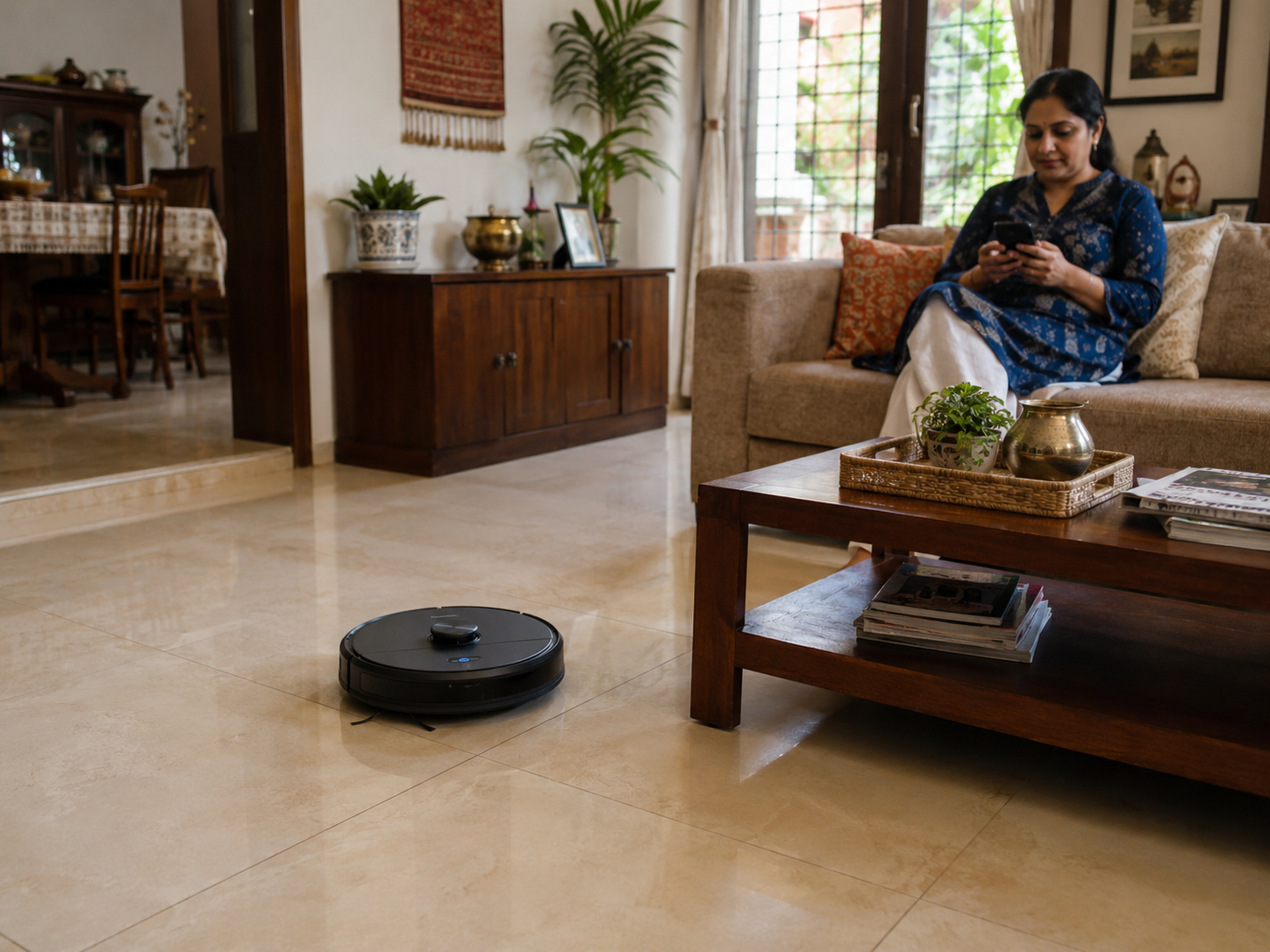
★★★★☆
Self-emptying / automated floor cleaning
Robot vacuums promise one of the most attractive upgrades in home cleaning: floors that get cleaned with very little day-to-day effort.
But Indian homes can be demanding environments for them.
There may be fine dust from open windows, hair, crumbs, kitchen debris, rugs, door thresholds, furniture legs, toys on the floor and different surfaces across the same home. Add daily sweeping habits and occasional wet mopping, and the obvious question is:
Can a robot vacuum genuinely handle everyday cleaning in an Indian household, or is it just an expensive gadget?
The short answer is yes, it can be genuinely useful — but it works best as a maintenance cleaner rather than a complete replacement for manual cleaning.
Here is what you should know before buying one.
Affiliate Disclosure: This article may contain affiliate links. If you purchase through one of these links, we may earn a commission at no additional cost to you. As an Amazon Associate, we earn from qualifying purchases.
The Short Answer
For many Indian homes, a robot vacuum can handle a large share of routine floor maintenance, especially:
- everyday dust
- hair
- crumbs
- small dry debris
- under-bed cleaning
- regular scheduled vacuuming
- light floor mopping on compatible models
Where it struggles is with jobs such as:
- sticky kitchen spills
- corners that the robot cannot physically reach
- stairs
- cluttered floors
- heavy stains
- deep scrubbing
- cleaning furniture and other raised surfaces
So the best way to think about a robot vacuum is not:
“Will this eliminate cleaning completely?”
It is:
“Can this reduce how often I need to sweep or vacuum the whole house myself?”
For many households, that is where the real value lies.
Are Robot Vacuums Suitable for Indian Homes?
Generally, yes — provided the home layout and your expectations suit the technology.
Robot vacuums are especially useful in homes with:
- mostly hard flooring
- relatively open floor areas
- regular dust accumulation
- pets or long hair
- people who are away during the day
- elderly family members who want to reduce repetitive sweeping
- households that prefer frequent light cleaning over occasional heavy cleaning
The biggest benefit is consistency.
A manual vacuum cleaner may be more powerful and flexible, but somebody still has to take it out and use it.
A robot can clean according to a schedule.
That means instead of waiting until floors visibly look dusty, you can have the machine run regularly and keep dirt from building up as quickly.
Indian Dust Is Where Robot Vacuums Can Make Sense
One of the most common cleaning frustrations in Indian cities is how quickly fine dust appears on floors.
Open windows, balconies, nearby traffic, construction and dry weather can all contribute to frequent dust accumulation.
A robot vacuum can be useful precisely because this is a repetitive cleaning problem.
Rather than waiting several days and then cleaning a heavily dusty floor, running the robot frequently can help maintain the floor between deeper cleaning sessions.
This is one reason robot vacuums are often more valuable when they are used regularly rather than occasionally.
Can a Robot Vacuum Replace Daily Jhadu?
In some homes, largely.
In others, only partly.
If your main daily cleaning requirement is removing dust, hair and small dry debris from relatively uncluttered floors, a robot vacuum may take over much of the sweeping workload.
You may still need manual cleaning for:
- tight corners
- behind certain furniture
- stairs
- balconies
- bathrooms
- heavily soiled areas
- places where the robot cannot enter
So it is better to think of a robot vacuum as reducing your dependence on daily manual sweeping rather than guaranteeing that you will never need a broom again.
What About Pocha?
This is where expectations need to be more realistic.
Many robot vacuums include a mopping function, but robot mopping is not necessarily equivalent to a thorough manual pocha.
For everyday maintenance, automated mopping can be convenient.
It may help with:
- light dust
- minor marks
- routine surface wiping
But dried food spills, oily kitchen marks and tougher stains may still require manual attention.
If mopping is a major reason you are buying the appliance, pay particular attention to how the specific robot handles:
- water dispensing
- mop-pad cleaning
- dirty-water collection
- carpet avoidance
- repeated mopping passes
More advanced docking systems can automate more of this process, but they also tend to make the complete setup larger and more complex.
Robot Vacuum vs Maid: Is It Really a Replacement?
Usually not.
A robot vacuum cleans floors.
Household cleaning involves much more than floors.
A cleaning professional may also handle:
- bathrooms
- kitchen surfaces
- dusting
- furniture
- balconies
- corners
- manually scrubbing stains
- moving objects while cleaning
A robot does none of these jobs particularly well — or at all.
Where it can help is by reducing one repetitive part of the workload.
That may still be valuable even if you continue using domestic help.
For example, the robot can run between regular cleaning visits or maintain floors in rooms that collect dust quickly.
Hard Floors: Where Robots Usually Make the Most Sense
Indian homes commonly use surfaces such as:
- vitrified tiles
- ceramic tiles
- marble
- granite
- wooden or laminate flooring
Robot vacuums are generally most straightforward to use on relatively smooth, level surfaces.
The machine can move around the home while continuously collecting loose debris.
Large transitions between rooms, raised thresholds or uneven flooring can create more difficulty.
Before buying, inspect your house for:
- raised bathroom entrances
- balcony tracks
- uneven room transitions
- thick rugs
- loose mats
These details can matter as much as suction specifications.
Rugs and Doormats Can Be Tricky
Small rugs are one of the more practical things to think about before bringing a robot vacuum home.
Very light mats may shift when the robot moves over them.
Loose tassels can also create problems.
Thicker carpets may require stronger carpet-handling capability, while some mop-equipped robots need a reliable way to avoid wetting carpeted areas.
You may find yourself adjusting a few things around the house before automated cleaning becomes genuinely effortless.
That could mean:
- moving very light mats
- securing cables
- keeping tassels away from the floor
- creating no-go areas in the app
- removing small objects before cleaning
Once the environment is robot-friendly, everyday use becomes much easier.
Navigation Matters More Than Gimmicks
A robot vacuum has to understand where it is going.
This is why navigation is one of the most important features to compare.
More capable models can create maps of the home and clean rooms systematically rather than moving around randomly.
Depending on the model, mapping features may allow you to:
- select individual rooms
- create cleaning zones
- set virtual boundaries
- prevent access to certain areas
- schedule rooms separately
For an Indian home with several bedrooms, furniture and multiple floor areas, good navigation can make the difference between a robot that feels useful and one that constantly needs rescuing.
What Is LiDAR, and Do You Need It?
LiDAR is a navigation technology used by many robot vacuums to help map their surroundings.
For buyers, the technical term is less important than what good mapping allows the robot to do.
A capable mapping system can make cleaning:
- more systematic
- easier to schedule by room
- less repetitive
- easier to customise
If you live in a small open apartment, basic navigation may be sufficient.
For larger or more complicated homes, stronger mapping and navigation features become more valuable.
Can Robot Vacuums Clean Under Beds and Sofas?
Often, yes — and this can be one of their biggest practical advantages.
Dust tends to collect under beds and large furniture precisely because those areas are inconvenient to reach manually.
A low-profile robot may be able to clean these spaces regularly.
But you should measure your furniture clearance before buying.
Do not assume every robot will fit under every bed or sofa.
Compare the robot's listed height with the clearance beneath your furniture.
Do Self-Emptying Robot Vacuums Make Sense?
A self-emptying dock takes automation a step further.
Instead of manually emptying the robot's dustbin after frequent cleaning cycles, the robot returns to a base that transfers collected dirt into a larger container.
This can be particularly attractive for:
- homes with pets
- dusty locations
- larger houses
- frequent cleaning schedules
- people who want minimum day-to-day interaction
The trade-off is space.
A self-emptying dock is considerably more substantial than a simple charging station.
So before paying extra for the convenience, ask yourself whether you have an appropriate permanent location for it.
Self-Emptying Is Convenient — Not Maintenance-Free
This distinction matters.
A self-emptying robot still requires attention.
Depending on the particular model and cleaning system, you may need to:
- empty or replace the dock's dirt container
- clean filters
- remove hair from brushes
- wipe sensors
- wash mop pads
- refill clean water
- empty dirty-water tanks
Automation reduces the frequency of manual intervention.
It does not eliminate maintenance completely.
Pets Make Robot Vacuums More Useful — and More Demanding
Pet owners are among the households that may see the biggest benefit from frequent robot cleaning.
Hair can accumulate quickly, particularly on open floors and around furniture.
Scheduled cleaning means the robot can collect hair before it forms larger clumps.
However, pet households should also pay close attention to:
- brush maintenance
- hair tangling
- dustbin capacity
- obstacle detection
- cleaning frequency
A robot that runs daily may be far more useful for pet hair than one brought out only once a week.
What About Long Human Hair?
Long hair can wrap around brushes and rollers.
This does not necessarily make a robot vacuum unsuitable, but it means brush design and maintenance deserve attention.
If several people in your household have long hair, check how easily the main brush can be removed and cleaned.
Even highly automated robots still benefit from occasional inspection.
Indian Kitchens Need Realistic Expectations
A robot vacuum can help collect:
- crumbs
- dry food particles
- dust
- loose debris
But an Indian kitchen can also involve:
- oil
- masala stains
- wet spills
- flour
- sticky food
- water around the sink
Those situations often require proper manual cleaning.
So a robot can be useful for keeping the kitchen floor tidy between deeper cleans, but it should not be viewed as a substitute for scrubbing.
Clutter Is the Enemy of Automation
A robot vacuum works best when the floor is reasonably clear.
Common obstacles include:
- charging cables
- children's toys
- socks
- plastic bags
- slippers
- lightweight objects
- trailing curtains
Newer obstacle-avoidance systems may handle some objects better than basic robots, but no system makes floor preparation completely irrelevant.
If you regularly have many items lying around, you may need a quick two-minute tidy before starting the robot.
Families With Young Children: Is a Robot Practical?
It can be.
Children tend to create exactly the kind of everyday mess that robot vacuums are good at maintaining:
- crumbs
- cereal
- hair
- small dry debris
But children's toys also create obstacles.
Blocks, craft materials, socks and small pieces on the floor can interfere with automated cleaning.
For families with young children, the robot may work best on a scheduled run after toys have been put away.
What About Stairs?
Robot vacuums are designed to detect drops, but they cannot clean stairs.
If you have a multi-storey home, you will need to think about cleaning each floor separately.
One robot may be physically moved between floors, depending on the mapping capabilities of the particular model.
Alternatively, households seeking maximum automation may eventually consider separate machines for different floors.
How Much Suction Power Do You Need?
Suction specifications are useful, but they should not become the only number you compare.
A robot vacuum's actual usefulness also depends on:
- brush design
- navigation
- floor contact
- cleaning pattern
- dustbin capacity
- obstacle handling
- software
- maintenance
A model with a higher advertised suction number is not automatically the better robot for your home.
For hard-floor cleaning, navigation and consistent coverage can be just as important.
Battery Life Matters More in Larger Homes
For small apartments, battery life may not be a major concern.
For larger homes, it becomes more important.
Some robots can return to the dock, recharge and then continue cleaning where they stopped.
That feature can be useful if the robot cannot complete your full floor plan on one charge.
When comparing models, think about your actual floor area rather than choosing battery specifications in isolation.
App Features: Useful or Unnecessary?
Some app features genuinely improve everyday use.
Useful capabilities may include:
- room-by-room cleaning
- scheduled cleaning
- virtual boundaries
- no-go zones
- map editing
- cleaning history
- suction adjustment
- mop settings
These features are particularly helpful in houses where some areas need daily cleaning while others need attention less often.
The ability to tell the robot:
“Clean the kitchen and living room after dinner”
can be more useful than dozens of rarely used smart-home features.
How Much Preparation Does a Robot Vacuum Need?
Initially, more than many advertisements suggest.
You may need to make your home robot-friendly by:
- removing loose cables
- lifting lightweight rugs
- moving fragile floor objects
- checking furniture clearance
- setting virtual boundaries
- identifying troublesome thresholds
Once this initial setup is done, routine cleaning becomes much more automated.
Think of it as setting up the environment once so the robot needs less supervision later.
Who Should Seriously Consider a Robot Vacuum?
A robot vacuum makes particular sense if you:
Have floors that become dusty every day
Frequent automated cleaning is where these machines are strongest.
Have pets
Daily hair collection can considerably reduce visible buildup.
Work long hours
Scheduled cleaning can happen while you are away.
Have back or mobility issues
Reducing repetitive sweeping may make everyday cleaning more manageable.
Live in a relatively uncluttered apartment
Open floor layouts are well suited to robotic cleaning.
Hate cleaning underneath furniture
The robot may reach areas you normally postpone cleaning.
Who May Be Better Off With a Regular Vacuum Cleaner?
A robot may not be the best first purchase if:
- your home has many levels
- floors are usually cluttered
- you need extensive deep cleaning
- you have many difficult thresholds
- most of your cleaning involves sofas, mattresses and furniture
- your budget only allows one cleaning appliance and you need maximum flexibility
A conventional vacuum cleaner is much more versatile.
It can clean floors, upholstery, stairs and difficult corners.
A robot provides automation rather than maximum flexibility.
Robot Vacuum vs Cordless Vacuum
These appliances solve different problems.
|
Robot Vacuum |
Cordless Vacuum |
|
Cleans automatically |
Requires manual operation |
|
Excellent for routine floor maintenance |
Better for targeted cleaning |
|
Can run on a schedule |
Useful whenever a mess appears |
|
Limited to accessible floor areas |
Can clean furniture and stairs |
|
May include automated mopping |
Usually focused on vacuuming |
|
Needs a robot-friendly floor |
Works in cluttered spaces more easily |
For some households, the ideal setup is not one or the other.
It is both.
The robot handles regular floor maintenance, while the cordless vacuum deals with stairs, sofas, corners and quick spot cleaning.
Robot Vacuum vs Traditional Canister Vacuum
A traditional vacuum generally offers more versatility and direct control.
A robot offers something different:
time saved through automation.
If you enjoy doing a thorough vacuum once or twice a week, the robot may not feel essential.
If you dislike seeing dust return the next day, frequent automated maintenance can be much more compelling.
What Should You Look for When Buying a Robot Vacuum in India?
1. Navigation and Mapping
For anything beyond a very small home, reliable mapping is worth prioritising.
2. Obstacle Handling
Consider how much furniture, clutter and loose objects your floors normally contain.
3. Vacuuming Performance
Look beyond headline suction figures and consider the complete cleaning system.
4. Mopping System
If mopping matters to you, compare how water is managed and how much maintenance is required.
5. Dock Type
Decide whether you need simple charging, self-emptying or a more comprehensive cleaning station.
6. Consumables and Spare Parts
Brushes, filters, mop pads and other replaceable parts will eventually need attention.
Before buying, check whether replacements for the particular model are readily available.
7. Service Support
A robot vacuum contains motors, sensors, wheels, batteries and electronic components.
After-sales support therefore matters more than it might for a basic cleaning tool.
8. Height
Measure your low furniture if under-bed and under-sofa cleaning is important.
9. Thresholds
Check whether your rooms have raised transitions that could prevent free movement.
10. App Quality
For a smart appliance you may use several times each week, good software can have a real effect on convenience.
Is a Budget Robot Vacuum Worth Buying?
It can be, particularly if your expectations are limited to routine vacuuming of relatively simple floor layouts.
You do not necessarily need the most sophisticated docking station or obstacle-avoidance system to benefit from automated cleaning.
However, budget models may require more manual interaction.
The important question is not simply:
“How cheap is it?”
Ask:
“Will it navigate my home reliably enough that I will actually use it?”
An inexpensive robot that constantly gets stuck may provide poorer value than a more capable model you can run every day.
Is a Premium Robot Vacuum Worth Paying For?
Premium models tend to make the most sense when you are paying for less intervention, not merely more specifications.
Features such as advanced mapping, better obstacle handling, self-emptying and automated mop maintenance can reduce the amount of work required from you.
That is especially valuable for larger homes and people who want cleaning to happen with minimal supervision.
For a small apartment, however, a simpler model may provide most of the practical benefit.
Can You Run a Robot Vacuum Every Day?
Frequent cleaning is one of the strongest reasons to own one.
Instead of allowing dust and hair to accumulate, scheduled cleaning can keep floors consistently maintained.
Whether daily cleaning is necessary depends on your home.
Pet owners, homes near busy roads and households with children may find frequent runs particularly useful.
Other households may prefer every second day or a customised room schedule.
Is a Self-Emptying Robot Vacuum Worth the Extra Cost?
It can be if convenience is your top priority.
Self-emptying systems reduce how often you need to handle the robot's small onboard dustbin.
They become more useful when:
- the robot runs frequently
- you have pets
- your home gets dusty quickly
- the floor area is large
For occasional cleaning in a small home, manually emptying the robot may not be enough of an inconvenience to justify a larger, more expensive dock.
Final Verdict: Can a Robot Vacuum Really Cope With an Indian Home?
Yes — with the right expectations.
A good robot vacuum can be extremely useful for controlling the everyday dust, hair and crumbs that appear repeatedly on Indian floors.
Its strongest role is maintenance cleaning.
Run it regularly, and you may find yourself sweeping or vacuuming manually far less often.
But it will not completely replace:
- deep cleaning
- manual mopping
- corner cleaning
- stairs
- furniture cleaning
- stain removal
For many households, that is perfectly acceptable.
The goal is not to eliminate every cleaning task.
It is to automate the boring, repetitive part.
And for a busy household where dust seems to reappear almost as soon as the floor has been cleaned, that can make a robot vacuum considerably more useful than it first appears.
FAQ
Are robot vacuums useful in India?
Yes. They can be particularly useful for regular removal of dust, hair, crumbs and dry debris from hard floors. Their effectiveness depends on home layout, clutter and the capabilities of the particular model.
Can a robot vacuum replace sweeping?
It can replace much of routine sweeping in suitable homes, although corners, stairs and inaccessible areas may still require manual cleaning.
Can a robot vacuum replace mopping?
Usually not completely. Robot mopping is best viewed as routine floor maintenance. Tough stains and sticky spills may still need manual scrubbing.
Is a robot vacuum good for marble and tiles?
Smooth, level hard floors are generally well suited to robotic cleaning. Always check the manufacturer's guidance for the specific model and flooring type.
Is a self-emptying robot vacuum worth it?
It can be worthwhile for people who run their robot frequently, have pets or want to minimise routine dustbin emptying. Smaller households may be satisfied with a standard charging dock.
Can robot vacuums handle pet hair?
Many households use them for regular pet-hair pickup, but brush maintenance and hair tangling should be considered when selecting a model.
Do robot vacuums work in cluttered homes?
They work best when floors are reasonably clear. Cables, toys, socks, lightweight rugs and other small items can interfere with cleaning.
Do I need LiDAR in a robot vacuum?
Not necessarily, but effective mapping becomes more valuable in larger or more complicated homes. The practical benefit is systematic cleaning and better control over rooms and no-go areas.
How often should I run a robot vacuum?
That depends on how quickly your floors become dirty. Dusty homes and homes with pets may benefit from daily cleaning, while others may only need several runs per week.
Is a robot vacuum better than a cordless vacuum?
Neither is universally better. A robot provides automation, while a cordless vacuum provides greater flexibility for stairs, sofas, corners and quick spot cleaning.