
Smart Ring vs Smartwatch: Which One Actually Makes More Sense?
21 September 2026 · Media Pitch Product Expert
Smart ring or smartwatch? Compare sleep tracking, fitness, battery life, comfort, GPS, notifications and costs to decide which wearable suits you.
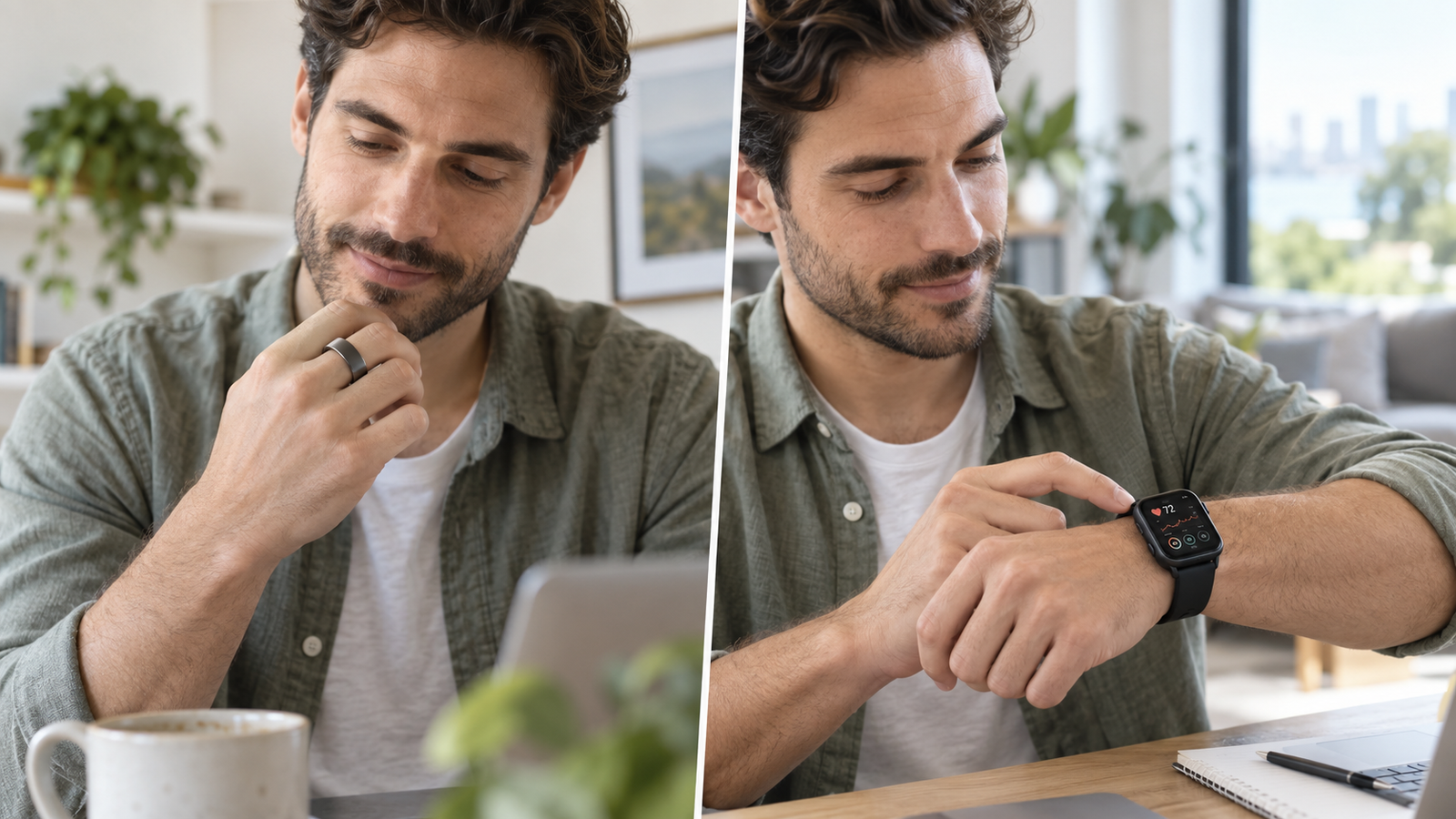
Smartwatches have been the default wearable for years. They track workouts, show notifications, display the time and, depending on the model, can handle calls, navigation, music and apps.
Smart rings take almost the opposite approach.
There is usually no screen demanding your attention. You wear the ring, let its sensors collect data and check the companion app when you actually want to see your sleep, activity or recovery information.
So if you're thinking about buying a wearable, does a smart ring now make more sense than a smartwatch?
For many buyers, the answer depends less on which device has the longer feature list and more on what you actually want a wearable to do.
Affiliate Disclosure: This article contains affiliate links. If you purchase through one of these links, we may earn a commission at no additional cost to you. As an Amazon Associate, we earn from qualifying purchases.
Smart Ring vs Smartwatch: The Short Answer
If you want workout tracking, a screen, notifications, GPS, apps and smartwatch functions, a smartwatch generally makes more sense.
If your priorities are sleep, recovery, passive health tracking, discreet design and fewer digital distractions, a smart ring deserves serious consideration.
For some people, the most interesting answer is actually neither/or: a smart ring can complement a traditional watch or even a smartwatch rather than replace it completely.
Why Smart Rings Are Suddenly Worth Considering
Smart rings remain a relatively young wearable category, particularly compared with smartwatches. In India, the category now includes established options from brands such as Samsung, Ultrahuman and Oura, although smart rings remain a much smaller segment than watches. Oura formally entered the Indian market in 2026, adding another major player to the category.
The attraction is easy to understand.
Instead of placing another display on your wrist, a smart ring tries to disappear into your daily routine.
You wear it.
It collects data.
You check the app later.
That makes the format particularly interesting for people who want the health-tracking side of wearable technology without having messages, calls and app alerts constantly appearing on their wrist.
Smart Ring vs Smartwatch at a Glance
|
Feature |
Smart Ring |
Smartwatch |
|
Sleep tracking |
Strong use case |
Strong use case |
|
Recovery tracking |
Strong use case |
Increasingly common |
|
Live workout information |
Limited |
Strong |
|
Built-in display |
Usually no |
Yes |
|
Notifications |
Phone/app based |
Directly on wrist |
|
Calls and messages |
Generally no |
Available on many models |
|
GPS |
Often absent from the ring itself |
Common on fitness-focused watches |
|
Apps |
Very limited |
Major advantage |
|
Battery life |
Usually several days |
Varies significantly by model |
|
Discreet appearance |
Major advantage |
More noticeable |
|
Digital distraction |
Low |
Potentially higher |
|
Sizing |
Important |
Strap is usually more forgiving |
|
Strength training |
Ring may need removing |
Usually easier to wear |
|
Best suited to |
Passive tracking |
Interactive wearable use |
The important word here is generally. Wearables vary considerably, so always check the specifications of the exact model you are considering.
1. Smart Rings Are Much Less Distracting
This may be their biggest advantage.
A smartwatch can become a miniature version of your phone.
Messages arrive.
Calls appear.
Calendar reminders vibrate.
Apps send notifications.
That can be convenient—but it can also create yet another screen competing for your attention.
A smart ring largely removes that problem because there is no conventional display to keep checking.
You still get the health information, but you normally view it when you deliberately open the accompanying smartphone app.
For buyers actively trying to reduce screen time, that can be a major selling point.
2. Smartwatches Are Far More Useful During Exercise
This is where the smartwatch remains difficult to beat.
During a run, walk, cycle or gym session, being able to glance at your wrist and see information such as:
- elapsed time
- heart rate
- pace
- distance
- workout duration
- exercise zones
can be extremely useful.
Smartwatches can show this information while you're exercising.
A ring without a screen cannot.
Some watches also provide built-in GPS and can track outdoor workouts without relying as heavily on a nearby phone. Apple, for example, supports workout tracking and GPS-based functionality on its current Watch line, while cellular models can also make calls and send messages away from the iPhone in supported circumstances.
If you're primarily buying a wearable for running, cycling or structured exercise, a smartwatch or sports watch will usually be the more practical format.
3. Smart Rings Make a Strong Case for Sleep Tracking
Sleeping with a large watch on your wrist isn't comfortable for everyone.
A ring takes up much less physical space, which is one reason the format has become closely associated with sleep and recovery tracking.
Current smart rings commonly track combinations of metrics related to sleep, heart rate, movement, temperature and recovery. Samsung's Galaxy Ring, for example, uses an accelerometer, optical biosignal sensor and skin-temperature sensor, while its data is viewed through Samsung Health.
That does not mean every smart ring will automatically track sleep more accurately than every smartwatch.
Accuracy depends on the individual device, algorithms, fit and the specific metric being measured.
The advantage is more straightforward: if you find a ring more comfortable to wear overnight, you're more likely to keep wearing it consistently.
And consistent wear is important for useful long-term trends.
4. Battery Life Often Favours Smart Rings—but Not Always
One of the easiest mistakes in this comparison is saying that smart rings always have better battery life.
Many do last several days.
For example, Samsung lists up to seven days for the Galaxy Ring. Ultrahuman lists approximately four to six days for its Ring AIR, while Oura currently states roughly five to eight days for the Oura Ring 4 depending on usage and configuration.
By comparison, Apple's current Watch Series 12 is rated for up to 24 hours of normal use, with longer operation available in Low Power Mode.
But this is not a universal ring-versus-watch rule.
Some sports watches can run for many days between charges. Battery performance varies enormously across the smartwatch market.
So don't compare categories.
Compare the two actual products you are considering.
5. A Smartwatch Can Potentially Replace Other Devices
A good smartwatch isn't simply a fitness tracker.
Depending on the model and ecosystem, it can provide:
- notifications
- calls
- messages
- maps and navigation
- music controls
- alarms and timers
- calendar access
- weather
- apps
- contactless functions where supported
- emergency features
- workout tracking
Apple's current Watch ecosystem, for example, supports calls, messaging, apps, fitness functions and multiple connected features directly from the wrist.
A smart ring deliberately does far less.
That can be its strength—but it also means you shouldn't buy one expecting a miniature smartwatch on your finger.
6. Smart Rings Can Work Better With Traditional Watches
There is another group of buyers for whom smart rings make particular sense:
People who already like wearing conventional watches.
If you own a favourite mechanical, analogue or luxury watch, replacing it with a smartwatch may not appeal to you.
A smart ring provides another option.
You can continue wearing the watch you already like while collecting wellness information from a completely different part of your body.
That makes smart rings unusual among wearables: they don't necessarily compete for the same piece of physical space as a watch.
7. Smart Rings Have One Big Buying Complication: Fit
You can tighten or loosen a watch strap.
A smart ring is less forgiving.
The sensors need appropriate contact with your finger, and fingers can also change size slightly throughout the day.
This makes sizing especially important.
Samsung, for example, advises users to choose a comfortably fitting finger without the ring being excessively tight or loose.
If a manufacturer offers a sizing kit, using it before ordering the final ring can be worthwhile.
Don't simply assume your usual jewellery ring size will translate perfectly to every smart-ring brand.
8. Gym Users Need to Think Carefully About Rings
Smart rings may sound ideal for all-day fitness tracking, but weight training introduces a practical issue.
A hard ring and a hard barbell are not always a good combination.
Samsung specifically advises removing its Galaxy Ring when lifting or handling heavy hard objects and during exercises involving gripping equipment such as dumbbells or bars.
That is worth considering if strength training is a major part of your routine.
A smartwatch may therefore be more convenient for someone who wants uninterrupted workout tracking during weightlifting sessions.
9. Ecosystem Compatibility Matters More Than You Might Expect
Before choosing any wearable, check what phone it works with.
Some devices offer broad compatibility. Others are much more closely tied to one manufacturer's ecosystem.
Samsung's Galaxy Ring, for example, is designed to work through the Galaxy Wearable and Samsung Health ecosystem and requires a Samsung account on a compatible Galaxy smartphone for setup and full access.
This means the best wearable on paper isn't necessarily the best wearable for your phone.
Compatibility should be one of the first things you check, not the last.
10. Don't Forget About Subscription Costs
The purchase price may not represent the complete cost of ownership.
Some wearable platforms include their core analysis without a mandatory recurring subscription, while others place parts of their experience behind membership plans.
Ultrahuman, for example, currently states that its Ring AIR does not require a mandatory subscription for its core features.
Subscription structures can change, so before purchasing any smart ring or smartwatch, check:
- whether membership is required
- which features work without it
- monthly or annual cost
- whether introductory membership is included
- what happens if you cancel
A cheaper wearable can become considerably more expensive if you keep it for several years and pay a recurring fee throughout that period.
So Who Should Buy a Smart Ring?
A smart ring makes particular sense if you:
- primarily care about sleep and recovery
- want passive health and wellness tracking
- dislike sleeping in a watch
- want fewer notifications
- prefer discreet technology
- already wear a traditional watch
- don't need live workout information on your wrist
- are comfortable checking insights through your phone
For this type of buyer, the apparent simplicity of a ring is not a limitation.
It is the point.
Who Should Buy a Smartwatch?
A smartwatch makes more sense if you:
- regularly track workouts
- run or cycle outdoors
- want GPS
- want live exercise information
- use notifications heavily
- want calls or messaging
- use apps from your wrist
- want one device for both fitness and everyday smart functions
If you're buying one wearable to do as much as possible, the smartwatch remains the more versatile option.
Could You Use Both?
Yes—and this may become an increasingly common setup.
Someone might use a smartwatch for workouts and daytime functionality while wearing a ring more consistently for sleep and recovery.
But there is an obvious drawback.
You are buying, charging and managing two expensive wearable devices that may collect overlapping information.
Unless you have a clear reason for owning both, start with the device that solves your most important problem.
Smart Ring vs Smartwatch: Which One Makes More Sense?
There isn't one universal winner.
The choice comes down to how interactive you want your wearable to be.
Choose a smart ring if you want technology that largely disappears into the background.
It can make particular sense for sleep, recovery and passive tracking without putting another screen in your life.
Choose a smartwatch if you want technology you actively interact with throughout the day.
For workouts, GPS, apps, calls, notifications and on-screen information, the watch is still the much more capable format.
The mistake is buying based on novelty.
Instead, ask yourself one question:
Do I want my wearable to give me information while I'm wearing it—or quietly collect information for me to review later?
Your answer will probably tell you whether a ring or a watch makes more sense.
Frequently Asked Questions
Is a smart ring better than a smartwatch?
Neither is universally better. Smart rings suit passive tracking, sleep, recovery and low-distraction use, while smartwatches are generally stronger for workouts, screens, apps, GPS and communication features.
Can a smart ring replace a smartwatch?
It can for users who mainly want health, sleep and recovery information. It is unlikely to replace a smartwatch for someone who regularly uses notifications, navigation, apps or live workout metrics.
Do smart rings have GPS?
Many current smart rings do not contain the same independent GPS functionality found in fitness-focused smartwatches. Check the specific model because activity-location tracking may depend on a connected smartphone.
Are smart rings good for sleep tracking?
Sleep and overnight recovery tracking are major smart-ring use cases. Their small form factor may also be more comfortable for some sleepers than a wristwatch, although tracking accuracy varies between products.
How long does a smart ring battery last?
It depends on the model and settings. Current examples range from several days per charge, with products such as the Galaxy Ring rated up to seven days and Oura Ring 4 typically listed at roughly five to eight days under specified conditions.
Can I wear a smart ring while lifting weights?
Check the manufacturer's instructions. Samsung, for example, advises removing the Galaxy Ring during weightlifting and activities involving gripping hard equipment because of potential injury or damage.
Do smart rings require a subscription?
Some do and some don't. Subscription policies vary by manufacturer and may change, so check which features are included before buying rather than comparing only the upfront hardware price.
The Bottom Line
Smart rings aren't simply smaller smartwatches.
They represent a different philosophy of wearable technology.
The smartwatch says: look at me and interact with me.
The smart ring says: wear me and forget about me.
If you want a digital companion for workouts and everyday communication, the smartwatch remains hard to beat.
If you're more interested in quietly understanding patterns in your sleep, activity and recovery without adding another screen to your day, a smart ring may make considerably more sense.