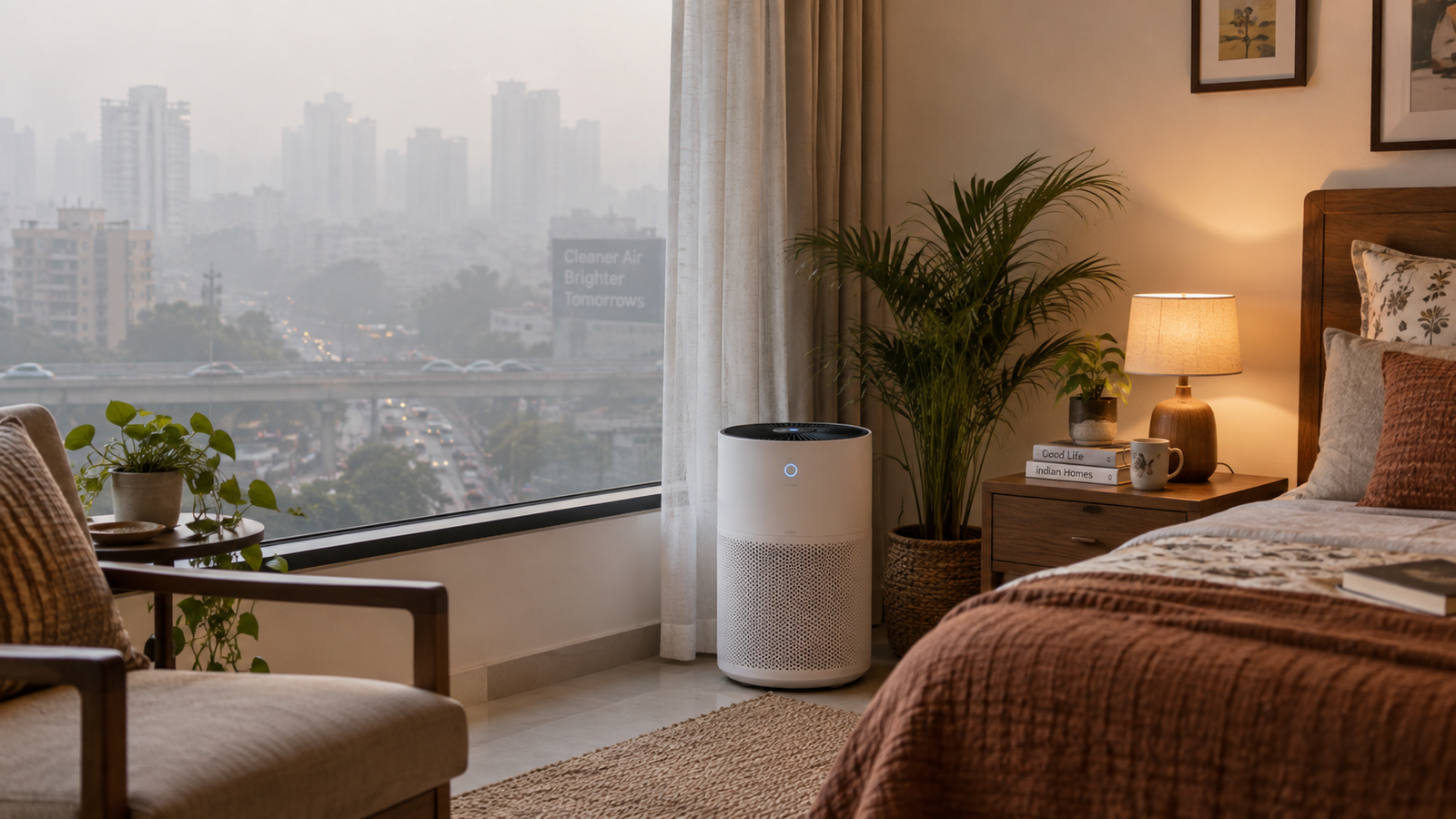
Thinking About an Air Purifier? Don't Wait Until the Smog Arrives
8 September 2026 · Media Pitch Product Expert
Winter pollution is approaching, but should you buy an air purifier now? Here's what actually matters — from CADR and HEPA filtration to room size and replacement-filter costs.
Affiliate Disclosure: This article contains affiliate links. If you purchase through one of these links, we may earn a commission at no additional cost to you. As an Amazon Associate, we earn from qualifying purchases.
Buying an air purifier in September can feel slightly premature.
The skies may not yet have turned grey. The windows are still open. And if you live in Delhi-NCR or another city that experiences a winter pollution spike, it can be tempting to wait until everyone starts talking about AQI again.
But that is precisely why before winter can be a sensible time to decide whether you need an air purifier.
Delhi-NCR authorities are already preparing for the 2026–27 pollution season. In September 2026, the Union Environment Ministry reviewed coordinated NCR air-pollution plans, while CAQM preparations specifically include measures intended to be in place before the winter season begins.
That does not mean everyone in India needs an air purifier.
It does mean that if you have already decided you want better control over airborne particles inside one or more rooms, waiting until pollution becomes severe is not necessarily the best time to begin researching one.
First: What Does an Air Purifier Actually Do?
A portable air purifier repeatedly pulls room air through a filtration system and returns filtered air to the room.
For particle pollution, the key component in many models is a HEPA filter.
The U.S. Environmental Protection Agency defines HEPA as a pleated mechanical filter capable, in theory, of removing at least 99.97% of airborne particles measuring 0.3 microns under the specified test conditions.
That sounds impressive, but there is an important distinction:
Filter efficiency is not the same as whole-room performance.
A brilliant filter inside an undersized purifier will not magically clean a large room quickly.
That is why buyers should pay attention to CADR and room size, not simply the words “HEPA filter” printed on the box.
So, Do You Actually Need One?
Possibly — but not for every household.
An air purifier makes the strongest case when your primary concern is reducing airborne particulate matter inside a particular room.
The EPA notes that portable air cleaners can reduce indoor particle pollution, including some fine particles such as PM2.5, but also stresses that no air cleaner removes every pollutant. Filtration should complement source control and appropriate ventilation rather than replace them.
In practical terms, an air purifier may be worth considering if:
- you live somewhere that regularly experiences poor outdoor air quality;
- you want to reduce airborne particles in a bedroom or living area;
- dust or smoke frequently enters from outside;
- you want supplementary filtration for a particular room;
- you spend substantial time indoors during high-pollution periods.
It may be less compelling if your local air quality is generally good and you are buying one simply because air purifiers are trending.
At this price level, “everyone should own one” is not a useful buying recommendation.
Why Buying Before Winter Can Make Sense
The strongest reason is not a discount.
It is time to choose properly.
Delhi-NCR experienced periods of very poor air quality earlier in 2026; in January, CAQM invoked Stage IV measures after Delhi's AQI rose sharply amid unfavourable meteorological conditions.
Buying ahead of the next high-pollution period gives you time to answer questions that matter considerably more than which model has the most attractive product page:
How large is the room?
What is the purifier's CADR?
How much do replacement filters cost?
How loud is it at the speed you will actually use?
Does it have a proper particle filter?
Will you realistically run it for several hours at a time?
Those questions determine whether an air purifier is genuinely useful in your home.
The Specification I Would Check First: CADR
If you remember only one technical term while comparing air purifiers, make it CADR.
CADR stands for Clean Air Delivery Rate.
Broadly, it tells you how much filtered air a purifier can deliver. Higher CADR generally means the machine can filter more air and can serve a larger space.
The EPA specifically recommends choosing a portable air cleaner with a CADR large enough for the room where it will be used.
This matters because room size dramatically changes what you need.
A purifier suitable for a compact bedroom is not automatically a sensible choice for a large open-plan living and dining area.
Don't buy by square footage alone
Manufacturer room-size claims can be useful, but read how they are calculated.
Room volume matters too.
A 250 sq ft room with a high ceiling contains more air than a 250 sq ft room with a lower ceiling.
If two purifiers cost roughly the same, I would generally pay more attention to credible CADR information than to flashy features such as colourful displays or dozens of app controls.
HEPA Matters — but Don't Stop There
A proper particle filter should be high on the checklist.
But buyers often make the mistake of thinking:
“It says HEPA, therefore it must be powerful enough for my room.”
Not necessarily.
Two machines can both use efficient filters yet circulate very different amounts of air.
Think of it this way:
Filter quality tells you what the filter can capture.
Airflow and CADR help tell you how much room air can actually pass through that filtration system.
You want both.
What About Smells and Gases?
This is where air-purifier marketing can become confusing.
HEPA filtration is primarily about particles.
Gaseous pollutants require different filtration media. Activated carbon is commonly used for certain gases and odours, and the EPA notes that the amount of carbon matters; a purifier merely containing some carbon does not mean it will remove every gaseous pollutant effectively.
So don't assume one filter solves every indoor-air problem.
If gaseous pollutants or odours are important to you, examine the actual filtration system rather than relying on a generic “multi-stage purification” claim.
Seven Things to Check Before Buying an Air Purifier
1. Room Size
Measure the room where the purifier will actually live.
Do not buy for your entire house unless the machine is genuinely designed for that application.
Portable air purifiers are normally intended to clean a particular room or area.
2. CADR
Look for a published Clean Air Delivery Rate and compare it with the room size.
If a listing talks endlessly about filters, Wi-Fi and displays but makes airflow performance difficult to understand, I would investigate further before purchasing.
3. Filter Type
For particle filtration, look carefully at the stated filtration system and verify what kind of particle filter the model actually uses.
Avoid assuming that marketing terms that merely sound similar to HEPA mean the same thing.
4. Replacement Filter Cost
This might be the most overlooked expense.
The purifier is the first purchase.
Filters are the recurring purchase.
Before buying the machine, find out:
- whether replacements are readily available;
- their current price;
- the manufacturer's replacement guidance;
- whether one filter or multiple components need periodic replacement.
A cheap air purifier with expensive or difficult-to-source filters may not be cheap to own.
The EPA also notes that filters need regular replacement because overloaded filters will not perform well.
5. Noise
An air purifier can look excellent on paper and still become annoying if you switch it to minimum speed every night because the higher settings are too loud.
That matters because filtration increases when more air passes through the filter. Higher fan speeds and longer operation generally increase the amount of air filtered.
For a bedroom, pay particular attention to noise specifications and credible owner feedback.
6. Sensors and Automatic Mode
A particulate sensor can make a purifier easier to use, especially if the machine automatically changes fan speed according to detected conditions.
But sensors should not distract you from the fundamentals.
I would choose:
good filtration + suitable CADR + affordable filters
before prioritising:
app + voice control + colourful screen + smart-home integration
The latter are conveniences. The former determine the core job.
7. Avoid Ozone-Producing Devices
Be cautious with purification technologies that intentionally generate ozone.
EPA guidance recommends choosing commercial portable air cleaners that do not produce ozone or other harmful by-products.
For most home buyers primarily interested in particulate filtration, a conventional mechanical filtration approach is easier to evaluate.
Bedroom or Living Room: Where Should You Put It?
If you are buying only one purifier, don't automatically put it in the largest room.
Think about where you spend the most continuous time.
For many households, that may be the bedroom.
A smaller bedroom can also require less purification capacity than a large living room, potentially allowing you to buy a suitably sized unit without jumping to a much larger machine.
If the family's evenings are primarily spent together in the living room, the calculation may be different.
What generally doesn't work well is expecting one small portable purifier in a hallway to clean an entire multi-room home.
Should You Keep the Windows Closed?
This depends on outdoor conditions and what you are trying to achieve.
An air purifier cannot control air quality effectively if polluted outdoor air is continuously entering the room faster than the machine can filter it.
At the same time, filtration should not be viewed as a permanent substitute for ventilation with clean outdoor air when conditions permit. EPA guidance treats filtration as a supplement to reducing pollution sources and appropriate ventilation.
A practical approach is therefore to pay attention to outdoor air quality and manage ventilation accordingly rather than following a universal “windows always open” or “windows always closed” rule.
Can an Air Purifier Make the AQI Display Drop?
A purifier with a particle sensor may show a reduction as airborne particulate levels fall around the device.
That can be satisfying.
But don't buy purely for the display.
What matters is actual filtration performance across the room.
Likewise, a built-in sensor's reading should not automatically be treated as equivalent to an official outdoor AQI monitoring station. They are measuring different environments and may use different sensors and methodologies.
What an Air Purifier Cannot Do
This deserves more attention than it gets in product listings.
An air purifier cannot:
- remove every indoor pollutant;
- prevent pollution from entering through every gap;
- replace cleaning;
- eliminate dust already settled on furniture and floors;
- replace source control;
- automatically make every room in a house clean;
- compensate for choosing a machine far too small for the room.
And it should not be marketed as a guaranteed treatment or prevention tool for medical conditions.
The EPA describes potential health improvements from portable HEPA filtration as generally small and not always noticeable, even though particle filtration can improve indoor air quality.
That makes a better buying promise:
Buy an air purifier to filter air — not to buy a miracle.
Who Should Consider Buying Before Winter?
Delhi-NCR households
This is the most obvious audience because winter air pollution is a recurring policy and public-health concern. Government agencies are already preparing for the 2026 winter season.
People replacing an old purifier
Before winter is a good time to check whether your current machine still works properly and whether its replacement filter is available.
You may discover that you need a ₹3,000 filter, not a ₹15,000 new purifier.
Families buying for a bedroom
A room-specific purchase is often easier to size correctly than trying to solve air quality throughout an entire home with one portable machine.
First-time buyers
Starting before peak pollution gives you time to compare filtration, CADR, noise and ownership costs instead of making a rushed purchase based solely on availability.
Who Can Probably Wait?
If you live in an area where outdoor particulate pollution is rarely a major concern and you don't have a clear indoor-air problem you are trying to solve, there is little reason to buy an expensive appliance just because winter is approaching elsewhere in India.
The same applies if you have not yet worked out which room you want to clean.
Start there.
An air purifier should solve a defined problem, not simply occupy a corner.
Our Rating: ★★★★★
Air purifiers earn five stars in this series not because everybody needs one, but because the category has:
- a clear job;
- measurable performance criteria;
- strong seasonal relevance;
- meaningful differences between products;
- substantial buyer research requirements;
- enough purchase value to justify comparing carefully.
This is precisely the kind of product where buying the wrong model can waste money — and where a good buying guide can genuinely help.
The Verdict: Do You Really Need an Air Purifier Before Winter?
If you live somewhere that experiences significant particulate pollution and want to reduce airborne particles inside a particular room, an appropriately sized air purifier is worth considering before winter rather than after pollution peaks.
But don't simply search Amazon for “best air purifier” and buy the first machine covered in badges.
Start with:
room size → CADR → filtration → noise → replacement-filter cost.
Smart features come afterwards.
The best air purifier isn't necessarily the most expensive one.
It is the one that can filter enough air for your room, at a noise level you'll tolerate, using filters you can afford to replace.
→ View Air Purifiers on Amazon
Prices, filter costs, specifications and availability change frequently. Check the current Amazon listing and manufacturer information before buying.
Frequently Asked Questions
Is an air purifier worth buying in India?
It can be worth considering in homes where airborne particulate pollution is a recurring issue. Its usefulness depends on local conditions, room size, purifier performance and how consistently the unit is operated.
When should I buy an air purifier for winter?
If winter pollution is predictable where you live, researching and purchasing before the peak season gives you more time to compare CADR, filters, noise and replacement costs without rushing.
What is the most important specification on an air purifier?
For particle filtration, CADR relative to your room size is one of the most useful specifications. Filter type, operating noise and replacement-filter availability are also important.
Is a HEPA air purifier enough for PM2.5?
HEPA filters are designed to capture very small airborne particles, but the purifier still needs sufficient airflow and capacity for the room. A high-efficiency filter alone does not guarantee good whole-room performance.
Should I buy an air purifier with activated carbon?
Activated carbon can be useful when gases and odours are part of your concern, but effectiveness depends on the design and quantity of filtration media. It is not a universal solution for all gases.
How often should an air-purifier filter be replaced?
There is no universal replacement interval. Follow the particular manufacturer's guidance and consider usage and pollution conditions. Check replacement-filter cost and availability before buying the purifier.
Is a bigger air purifier better?
Not automatically. What matters is having enough filtration capacity for your room. An oversized machine may offer additional airflow or allow quieter operation at lower speeds, but may also cost more to buy, run and maintain.