Cleaning Gadgets That Save You From Bending and Scrubbing: Are Electric Spin Scrubbers Worth It?
29 August 2026 · Media Pitch Product Expert
Motorised brushes and long extension handles promise to take some of the hard work out of bathroom cleaning. Here's when an electric spin scrubber makes sense -- and when a normal brush is enough.
★★★★★
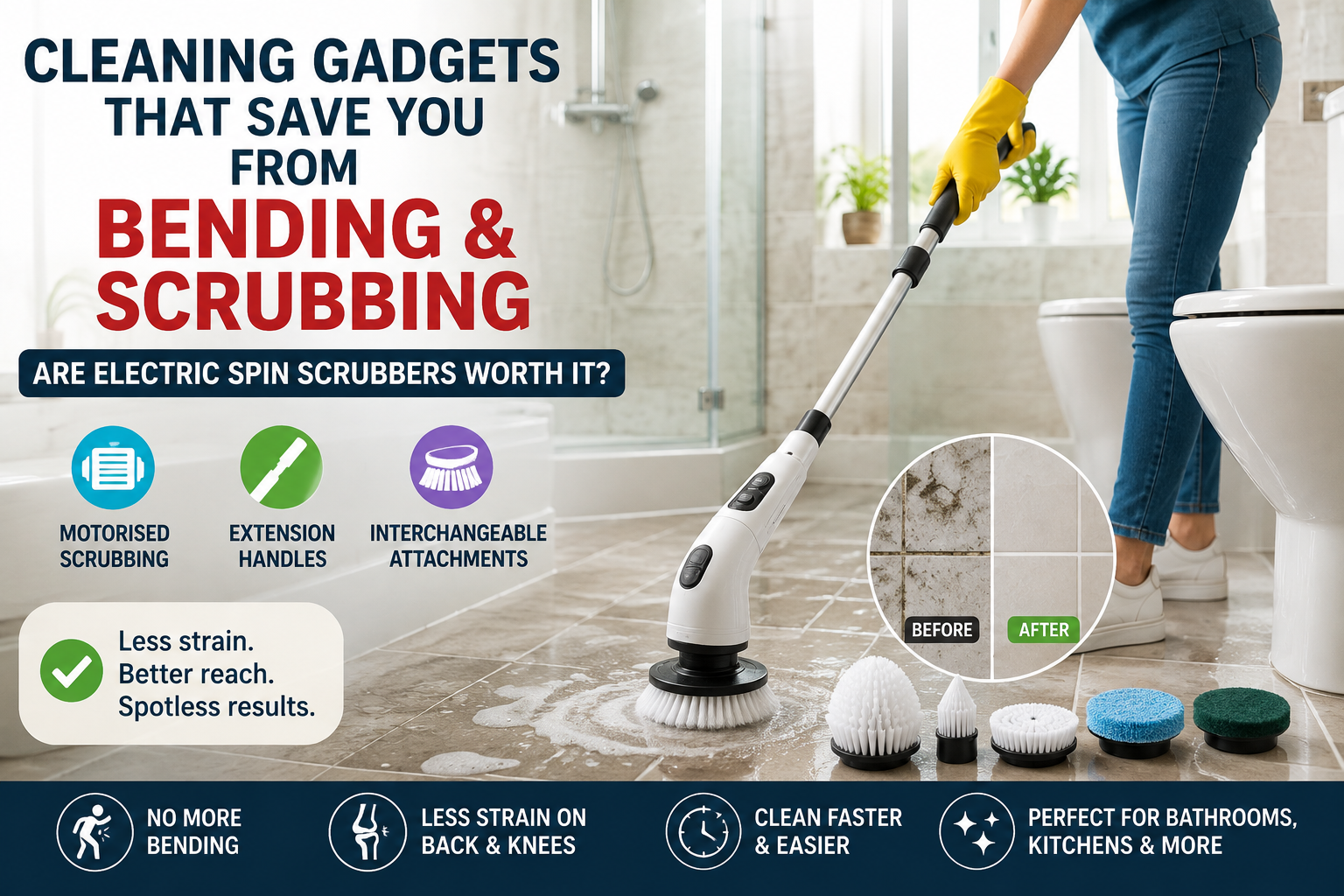
Motorised scrubbing + extension handles + interchangeable attachments
Short answer: An electric spin scrubber can make bathroom and floor cleaning noticeably less physically demanding by letting a motorised brush do much of the repetitive scrubbing while a long handle helps you reach floors, shower walls and awkward corners without constantly crouching. It will not eliminate cleaning, however, and the right brush head, cleaning product and surface compatibility still matter.
Cleaning the bathroom often involves two particularly unpleasant jobs: bending down and scrubbing hard.
Floor tiles mean crouching. Shower corners require awkward stretching. Grout lines can demand repeated back-and-forth brushing. And by the time you reach the area behind the toilet, enthusiasm for a spotless bathroom may have disappeared entirely.
Electric spin scrubbers are designed around a simple idea: let a motor move the brush while you guide it.
Add an extension handle and several brush attachments, and the result is one of those cleaning gadgets that can solve a genuine household problem rather than merely adding another appliance to the cupboard.
Affiliate Disclosure: This article may contain affiliate links. If you purchase through one of these links, we may earn a commission at no additional cost to you. As an Amazon Associate, we earn from qualifying purchases.
What exactly is an electric spin scrubber?
An electric spin scrubber is a powered cleaning brush.
Instead of manually moving a scrub brush backwards and forwards over a dirty surface, its motor drives a rotating or oscillating cleaning head. Many models are cordless, while longer versions may include telescopic or extension handles.
Different attachments can then be used for different areas.
Current powered scrubbers from established tool manufacturers illustrate the basic concept well. BLACK+DECKER, for example, offers rechargeable scrubbers with telescoping poles and different washable cleaning pads, while Ryobi sells powered scrubbers with interchangeable brushes of different shapes and bristle stiffnesses.
That versatility is arguably more important than the novelty of having a spinning brush.
Why are electric spin scrubbers becoming appealing?
Because they address something traditional brushes do badly:
Reach.
A normal handheld scrub brush forces your hand to remain close to whatever you are cleaning.
Cleaning the floor?
You bend.
Cleaning the bottom of a bathtub?
You bend.
Cleaning high bathroom tiles?
You stretch.
Cleaning behind a toilet?
You perform an uncomfortable piece of household gymnastics.
An electric scrubber with an extension pole lets you put more distance between your hands and the cleaning surface. BLACK+DECKER specifically describes its telescoping scrubber pole as allowing users to clean floors and higher areas, while its separate extension pole is intended for hard-to-reach places including tubs, shower walls and areas behind toilets.
That is the category's strongest selling point.
It isn't simply “electric is better than manual.”
It is:
“Can I clean this area without spending the next ten minutes crouched over it?”
Where an electric spin scrubber makes the most sense
1. Bathroom floors
This is probably the most obvious application.
Instead of kneeling down with a small hand brush, a long-handled scrubber allows you to remain more upright while guiding the cleaning head over the floor.
The motor supplies the repetitive brush movement.
You still have to move the tool around the room and apply an appropriate cleaner where required, but considerably less of the cleaning action needs to come from your wrist and arm.
2. Shower walls and tiles
Vertical surfaces are another good use case.
With a suitable extension handle, the same tool can move from lower tiles to sections that would otherwise require bending or stretching.
Some powered scrubber systems are explicitly designed for bathroom surfaces including tiles, tubs and shower areas.
3. Grout lines
Grout can be frustrating because dirt sits in narrow channels where a broad cleaning cloth is ineffective.
This is where attachment shape becomes important.
A smaller or more focused brush can concentrate the scrubbing action over grout lines rather than spreading it across the entire tile.
Not every attachment is appropriate for every surface, however, so the manufacturer's guidance should take priority over aggressive scrubbing.
4. Around taps, edges and corners
A large round brush is useful for open surfaces.
It is less useful when the dirt is sitting in a tight corner.
That is why attachment choice matters so much.
Depending on the model, electric scrubbers may offer smaller detail brushes, rounded heads, flatter brushes or different bristle stiffnesses. Ryobi, for example, currently offers multiple soft, medium and hard-bristle accessories, while its compact detail scrubber is supplied with several attachments intended for surfaces such as tile and grout.
5. Bathtubs and lower surfaces
Cleaning the bottom and sides of a bathtub usually involves leaning over the edge for an extended period.
An extension pole can make these areas easier to reach from a more comfortable position.
Again, this doesn't mean zero effort. You still need to control and position the tool.
But reducing repetitive hand scrubbing is precisely where the powered design earns its keep.
What the different brush heads are actually for
The number of accessories in the box can make one electric scrubber look dramatically better than another.
Don't choose purely by attachment count.
A set of four genuinely useful heads can be more valuable than a box containing ten variations you never use.
As a general buying principle, look for attachments covering three jobs:
|
Brush type |
Most useful for |
|
Broad/flat brush |
Floors and larger tile areas |
|
Rounded brush |
Baths, sinks and curved surfaces |
|
Narrow/detail brush |
Grout, edges and corners |
|
Softer pad/brush |
Surfaces requiring gentler cleaning |
The exact recommended uses vary by manufacturer.
That last point is important because more aggressive does not automatically mean cleaner. A hard brush that works well on a robust surface could be unsuitable for something delicate.
Does an electric scrubber completely eliminate manual scrubbing?
No.
This is where the advertising around cleaning gadgets can sometimes create unrealistic expectations.
An electric scrubber provides the repetitive brush movement.
It does not magically dissolve every stain.
Results will still depend on:
- what caused the dirt or stain;
- how long it has been there;
- the cleaning solution being used;
- the brush or pad;
- the surface material;
- how much contact the brush has with the surface.
Some areas may still need pre-treatment or additional cleaning.
So think of an electric spin scrubber as an effort-reducing tool, not an automatic cleaning robot.
Electric spin scrubber vs normal cleaning brush
|
Consideration |
Manual Brush |
|
|
Repetitive scrubbing |
Motorised |
Done by hand |
|
Floor reach |
Excellent with long handle |
Usually requires bending |
|
High wall reach |
Better with extension pole |
Limited |
|
Tight corners |
Good with correct attachment |
Often excellent |
|
Setup |
Requires charged battery/power |
None |
|
Maintenance |
Brush heads + battery/tool |
Very little |
|
Storage |
Requires more space |
Minimal |
|
Purchase cost |
Higher |
Very low |
|
Maximum control |
Good |
Excellent |
|
Occasional tiny jobs |
Can be excessive |
Ideal |
For five minutes of cleaning a small sink, a manual brush may be quicker.
For an entire bathroom floor and wall-cleaning session, the powered option becomes much more interesting.
Seven things to check before buying an electric spin scrubber
1. Handle length
If your main reason for buying one is to avoid bending, this should be near the top of your checklist.
Look at the usable length rather than simply accepting the word “extendable.”
Ask:
Can I comfortably reach my floor while standing naturally?
Also consider whether the handle collapses for storage. Some current extension systems are specifically designed to telescope or collapse.
2. Brush attachments
Think about your bathroom rather than the number printed on the box.
For example:
Mostly tiled floor?
Prioritise a broad cleaning head.
Lots of grout?
Look for a detail attachment.
Curved bathtub or wash basin?
A rounded brush may be useful.
Different surface types?
A system offering different brush stiffnesses can provide more flexibility.
3. Cordless design
Cordless operation is particularly useful in bathrooms because you can move around without dragging a mains cable behind you.
But cordless also means batteries.
Check the manufacturer's claimed runtime, charging method and whether the battery is built in or replaceable.
Do not assume that every similarly sized scrubber offers similar runtime.
4. Water resistance
This deserves careful attention.
A product being intended for bathroom cleaning does not automatically mean every part can be submerged.
Specifications differ substantially.
For example, BLACK+DECKER specifically describes some of its scrubbers as submersible, while Ryobi gives an IPX7 water-resistance rating for one of its compact detail scrubbers. Those claims apply to those particular products -- not to electric scrubbers as a category.
Before using any powered cleaning device near water, follow its manufacturer's instructions.
5. Brush replacement availability
Brush heads are wear items.
If you intend to use the scrubber regularly, check whether replacement heads are available independently.
An inexpensive machine becomes poor value if the entire product effectively becomes disposable when a brush wears out.
6. Weight
A longer handle eliminates some bending but introduces another consideration: you have to hold the machine.
An unnecessarily heavy scrubber may become tiring during longer cleaning sessions.
This matters particularly when cleaning vertical tiles because you are supporting more of the tool's weight rather than simply resting the head against the floor.
7. Storage
Long handles are useful when cleaning and inconvenient when storing.
Check whether the handle:
- telescopes;
- separates into sections;
- includes a hanging point;
- fits wherever you store mops and brooms.
A gadget that is awkward to retrieve is less likely to become part of your regular cleaning routine.
What surfaces can you use an electric spin scrubber on?
This depends entirely on the model, attachment and surface.
Common applications promoted by established manufacturers include tile, tubs, showers, grout and other bathroom surfaces. Some powered scrubber systems also offer pads or brushes intended for other household cleaning jobs.
But don't translate that into:
“Safe on everything.”
Before using a rotating or oscillating brush on:
- polished stone;
- delicate finishes;
- coated fixtures;
- painted surfaces;
- acrylic;
- glass;
- easily scratched materials,
check both the scrubber manufacturer's instructions and the surface manufacturer's cleaning recommendations.
When uncertain, test an inconspicuous area first.
Who will get the most value from one?
An electric spin scrubber makes particular sense for someone whose cleaning routine contains large areas of repetitive scrubbing.
For example:
Someone cleaning a tiled bathroom every week
The long handle and powered head directly address two unpleasant parts of that job.
Someone with a large shower enclosure
Being able to move from lower surfaces to higher tiles without constantly switching tools can be convenient.
Busy households
When cleaning already competes with work, children and everyday chores, reducing the physical effort involved in one task may make regular maintenance easier to keep up with.
People who simply dislike floor scrubbing
There doesn't have to be a deeper reason.
If manually scrubbing tiles is the household job you repeatedly postpone, a gadget specifically designed to make that task easier may earn its storage space.
Who probably doesn't need one?
You can probably skip an electric spin scrubber if:
- your bathroom is very small;
- most cleaning jobs take only a few minutes;
- you are perfectly comfortable using a normal brush;
- storage space is extremely limited;
- you dislike maintaining rechargeable gadgets;
- you need detailed hand-cleaning more often than large-area scrubbing.
A ₹100 brush that you actually use is a better cleaning tool than an electric gadget permanently sitting inside a cupboard.
Don't buy one just because it has 10 attachments
This is perhaps the easiest trap in this category.
Amazon listings and marketplace products can compete heavily on numbers:
5 heads.
7 heads.
9 heads.
12 accessories.
But the more useful questions are:
Does it have the heads I actually need?
Can I replace them later?
Is the extension handle long enough?
Is it suitable for wet bathroom use?
Is the tool comfortable enough to use for the duration of my normal cleaning session?
These characteristics will affect everyday usefulness far more than accessory count alone.
Is an electric spin scrubber worth buying?
Yes -- if bending and repetitive scrubbing are the parts of cleaning you most want to reduce.
That is the clearest case for buying one.
A good electric scrubber does not make the bathroom clean itself. You still need detergent where appropriate, you still need to guide the brush, and you still have to rinse or wipe surfaces afterwards.
What it changes is where the scrubbing force comes from.
Instead of repeatedly moving a hand brush, the motor supplies much of that motion.
And instead of bringing yourself down to floor level, a sufficiently long handle brings the cleaning head to the floor.
That combination can turn an unpleasant bathroom-cleaning session into a more manageable job.
For small, occasional cleaning tasks, stick with a normal brush.
But if every weekend finds you crouched over bathroom tiles thinking, “There has to be an easier way to do this,” an electric spin scrubber is one cleaning gadget that addresses the problem directly.
FAQs
Do electric spin scrubbers really work?
Electric scrubbers use powered rotating or oscillating heads to provide repetitive scrubbing action. They can make large cleaning jobs easier to work through, but performance still depends on the stain, surface, brush attachment and cleaning solution.
Can an electric spin scrubber clean grout?
Many scrubber systems offer smaller or specialised brushes suitable for detailed cleaning around grout. Always use an attachment appropriate for the surface.
Do electric scrubbers stop you having to bend down?
A model with a sufficiently long extension handle can substantially reduce the need to bend when cleaning floors and low surfaces. Handle length should therefore be a major buying consideration.
Can I use an electric spin scrubber in a wet bathroom?
Only according to the manufacturer's instructions. Water-resistance specifications vary between products, so never assume that a powered scrubber or its charging components can be immersed in water.
Can electric scrubbers scratch tiles?
The risk depends on the tile finish, brush material, bristle stiffness and cleaning method. Use the recommended attachment and test unfamiliar combinations on an inconspicuous area first.
Is an electric spin scrubber better than a manual brush?
For larger surfaces and jobs requiring prolonged repetitive scrubbing, a powered scrubber can be more convenient. A manual brush remains cheaper, simpler and often better for very small or highly detailed cleaning jobs.
What attachments should an electric spin scrubber have?
For most homes, a broad brush for floors, a rounded head for curved surfaces and a narrower detail brush for grout and corners form a useful basic set.