Why Magnetic Power Banks Are Becoming a Better Everyday Carry
30 August 2026 · Media Pitch Product Expert
Magnetic power banks snap onto compatible phones and charge without a dangling cable. Here's why they're convenient—and where traditional power banks still win.
★★★★★
Cable-free magnetic charging + compact form
Short answer: A magnetic power bank can be one of the most convenient ways to top up a compatible phone away from a socket. Instead of connecting a cable and carrying a separate battery in your hand or bag, the power bank attaches to the back of the phone and charges wirelessly. The trade-off is that wireless charging is generally less efficient than wired charging, and compatibility, magnetic strength, capacity and heat management matter more than they do with a basic wired power bank.
Most power banks solve one problem and create another.
They give you extra battery life, but they also mean remembering to carry:
- the power bank;
- the right charging cable;
- sometimes an adapter;
- and enough pocket or bag space for all of it.
Then, when your phone is running low, you end up holding a phone with a cable dangling from a rectangular battery pack.
Magnetic power banks try to simplify that whole routine.
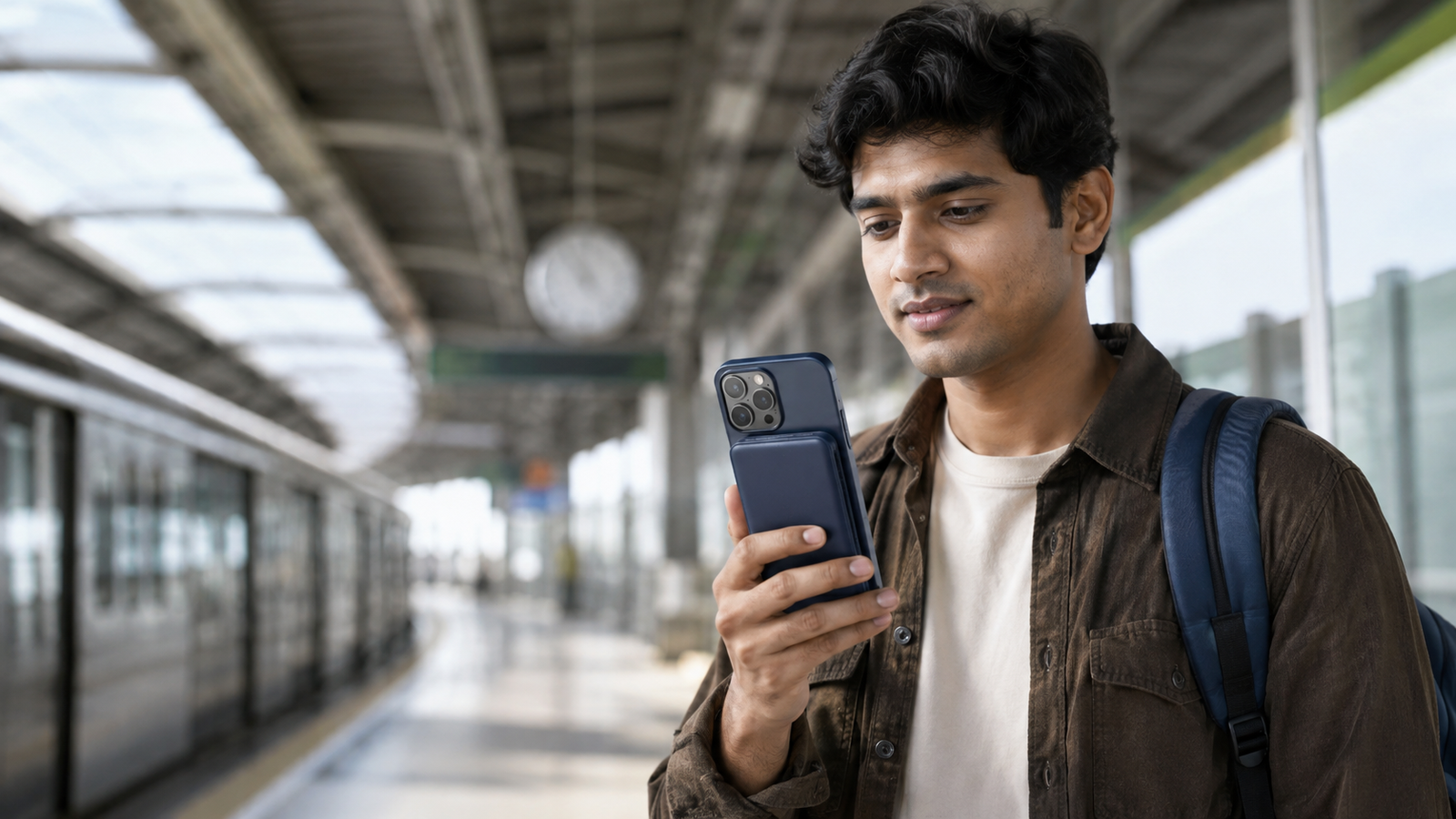
Snap one onto the back of a compatible phone and it becomes part of the phone while charging.
No loose cable between the battery and handset. No hunting around your bag for the right connector. No power bank hanging from a wire.
That convenience is the real reason the category is interesting.
Affiliate Disclosure: This article may contain affiliate links. If you purchase through one of these links, we may earn a commission at no additional cost to you. As an Amazon Associate, we earn from qualifying purchases.
What is a magnetic power bank?
A magnetic power bank is a portable battery designed to attach magnetically to the back of a compatible smartphone while charging it wirelessly.
The best-known example of this concept is Apple's MagSafe system. Apple describes compatible MagSafe battery packs as attaching magnetically to the back of supported iPhones while charging them wirelessly.
The broader market now also includes Qi2 accessories.
Qi2's Magnetic Power Profile standardises the magnetic arrangement used to align compatible phones and chargers. The Wireless Power Consortium says the specification defines factors including magnet layout, dimensions and holding force, helping certified devices line up correctly across different brands.
That means magnetic charging is increasingly becoming more than an iPhone-only accessory idea.
Why magnetic alignment matters
Wireless charging works best when the charging coils in the phone and charger are positioned correctly.
Traditional wireless charging pads rely on you placing the phone roughly in the right place.
Magnetic systems simplify that.
The magnets guide the charger into alignment and keep it attached.
That sounds like a small improvement, but with a portable power bank it changes the way you use the product.
Instead of:
phone + cable + power bank
you get:
phone + attached battery
That is much easier to carry while walking, sitting in a café, waiting at an airport or using public transport.
The biggest advantage: less friction
Magnetic power banks aren't necessarily the best choice because they store the most energy.
Their strength is that they remove several small annoyances from portable charging.
No cable between phone and battery
You may still need a cable later to recharge the power bank itself, but you don't need one connecting the bank to the phone while you're using it wirelessly.
The battery stays attached
A traditional power bank may need to sit in your pocket or bag while a cable runs to your phone.
A magnetic model travels with the handset.
You can keep using your phone
Apple explicitly notes that MagSafe batteries and chargers attach magnetically so the phone can still be held and used while charging.
That makes the format especially attractive when you need a quick top-up rather than an overnight-sized recharge.
Why you may actually remember to carry one
The best power bank is useless if it stays at home.
And that happens surprisingly easily with large battery packs.
A magnetic power bank has a better chance of becoming part of your everyday carry if it is:
- compact;
- thin enough for a pocket or small bag;
- easy to attach;
- easy to recharge;
- comfortable enough to use with your phone.
That can make a smaller magnetic bank more useful in practice than a much larger conventional power bank you rarely bother carrying.
This is why capacity alone should not decide the purchase.
Five situations where a magnetic power bank makes particular sense
1. You regularly finish the day with 20–30% battery
Not everyone needs a huge emergency battery.
If your phone usually survives until late afternoon but occasionally needs a boost before the commute home, a compact magnetic bank can suit that pattern extremely well.
Attach it for a while, add some charge and remove it again.
2. You travel light
If your everyday bag is small—or you don't carry one at all—the reduced cable clutter can be valuable.
A compact magnetic power bank can fit into a pocket more naturally than a larger battery plus a separate cable.
3. You use your phone constantly while travelling
Think:
- Google Maps;
- ride-hailing apps;
- train tickets;
- boarding passes;
- photography;
- messaging;
- mobile payments.
These are exactly the situations where you may need to charge the phone while continuing to use it.
A magnetic battery keeps the setup relatively self-contained.
4. You frequently forget charging cables
This is one of the category's simplest advantages.
Provided the power bank itself is charged, there is no separate phone-to-power-bank cable to remember for wireless charging.
5. You want an emergency top-up rather than maximum capacity
Magnetic power banks are often most compelling as battery extenders, not as replacements for large high-capacity power banks.
If you just want enough extra power to get through an evening, commute or travel delay, compactness can matter more than huge capacity.
Magnetic power bank vs regular power bank
|
Consideration |
Regular Wired Power Bank |
|
|
Phone-to-bank cable |
Not required for wireless charging |
Usually required |
|
Convenience while walking |
Excellent |
Less convenient |
|
Magnetic attachment |
Yes, on compatible devices |
No |
|
Charging efficiency |
Lower than wired in many situations |
Generally better |
|
Maximum capacity |
Often more compact-focused |
Wide range available |
|
Heat |
Can become more noticeable during wireless charging |
Usually less of an issue |
|
Compatibility |
Must be checked carefully |
Usually broad with correct cable |
|
Fastest charging |
Not always |
Often better via USB-C PD |
|
Everyday carry |
Excellent if compact |
Depends on size |
|
Long trips |
Useful, but capacity may be limiting |
Large models often better |
The important distinction is:
Magnetic power banks optimise for convenience.
Traditional power banks often optimise for capacity and charging performance.
What phones work with magnetic power banks?
This is where you should slow down before buying.
MagSafe-compatible iPhones
MagSafe-compatible iPhones are designed for magnetic attachment with supported chargers and battery accessories. Apple states that MagSafe batteries attach directly to supported iPhones or compatible MagSafe cases.
Qi2-compatible phones
Qi2 expands magnetic alignment beyond Apple's proprietary ecosystem by defining a standard Magnetic Power Profile. Certified devices are designed around the same magnetic alignment principles.
Other phones
Some phones can still use wireless charging but may require:
- a magnetic case;
- an adhesive magnetic ring;
- or another compatible accessory.
However, adding magnets does not automatically make a phone Qi2-compatible or guarantee optimal wireless charging.
Check your phone and power bank combination specifically.
Don't assume “magnetic” means “MagSafe”
Marketplace listings often use terms such as:
MagSafe compatible
MagSafe style
Magnetic wireless charger
These descriptions are not necessarily equivalent.
A product may attach magnetically without being officially MagSafe-certified.
Similarly, a product may support Qi wireless charging without supporting the full Qi2 Magnetic Power Profile.
When possible, look for clear manufacturer documentation rather than relying on the listing title.
Capacity: how much do you really need?
Power-bank capacity is usually stated in milliamp-hours, or mAh.
Common compact magnetic batteries may prioritise portability, while larger models provide more stored energy but add thickness and weight.
Rather than choosing the biggest number automatically, think about your use case.
Choose smaller and lighter if:
- you want an emergency boost;
- you carry the power bank every day;
- pocketability matters;
- you usually have access to a charger later.
Consider higher capacity if:
- you travel frequently;
- your phone battery drains heavily;
- you may be away from sockets all day;
- you want multiple top-ups.
Remember that the labelled capacity of a power bank is not the exact amount your phone receives.
Energy is lost during voltage conversion and charging, and wireless charging adds further losses.
So a 5,000mAh power bank does not mean a 5,000mAh phone battery will necessarily receive a complete 0–100% charge.
Wireless charging is convenient—but wired charging still has advantages
This is one of the most important trade-offs.
A magnetic power bank may be easier to use.
A cable may still be faster and more efficient.
Apple's current support guidance shows that wired fast charging can reach significantly higher rates on compatible iPhones when used with suitable USB-C power adapters, while wireless charging performance depends on the specific MagSafe setup and phone generation.
So if your priority is:
maximum charge in minimum time
wired charging is often the better choice.
If your priority is:
attach it and keep moving
magnetic charging becomes more attractive.
Heat matters more with wireless charging
Wireless charging naturally creates some heat.
The phone may also be:
- running navigation;
- using mobile data;
- recording video;
- sitting in sunlight;
- inside a thick case.
Combine those factors and temperatures can rise.
Apple states that iPhones may automatically slow or pause charging when they become too warm, and its guidance applies to wired, MagSafe and other wireless charging methods.
That means slower charging in a hot environment doesn't necessarily indicate a defective power bank.
The phone may simply be protecting the battery.
Seven things to check before buying a magnetic power bank
1. Compatibility
This should be first.
Check your exact phone model.
Then check:
- MagSafe support;
- Qi2 support;
- wireless charging support;
- case compatibility.
Do not buy based on “works with smartphones” alone.
2. Certification
Where applicable, look for clearly stated Qi2 or other recognised charging certification.
Certification gives you more useful information than a vague claim such as “15W magnetic fast charger.”
3. Wireless output
Check the manufacturer's specified wireless charging rate for your phone.
Do not assume the highest wattage printed on the listing applies to every compatible device.
Wireless charging speed can depend on both the charger and phone.
4. USB-C wired output
This feature can be extremely useful.
Some magnetic power banks can also charge a phone through USB-C.
That gives you two modes:
wireless when convenience matters
and
wired when speed or efficiency matters more.
For many buyers, that is the best combination.
5. Thickness and weight
A power bank attached to the back of your phone changes how the phone feels.
A device that looks compact in a product photo can still make a large phone feel bulky.
If everyday carry is your main reason for buying, dimensions and weight deserve more attention than impressive capacity numbers.
6. Magnetic strength
The bank needs to stay attached during normal use.
A weak magnetic connection can become frustrating very quickly.
However, actual grip can also depend on the phone case.
Use a case explicitly designed for magnetic charging if you want the most predictable attachment.
7. Pass-through charging
Some power banks allow you to charge the power bank while it charges the phone.
This can be useful on a bedside table or hotel desk because the battery can effectively act as a wireless charging surface.
But don't assume every model supports this behaviour.
Verify it from the manufacturer.
What about cases?
Cases can make or break the experience.
A thick non-magnetic case can reduce attachment strength or interfere with wireless charging.
For MagSafe or Qi2-style magnetic use, a compatible magnetic case is usually the safest choice.
Apple specifically references MagSafe-compatible cases and sleeves when describing magnetic charging.
If you already use a favourite case, check compatibility before buying the battery.
Can you leave a magnetic power bank attached all day?
You can physically keep many magnetic batteries attached while using the phone, but that does not necessarily mean you should treat one as a permanent extension of the device.
Continuous wireless charging may create extra heat, and modern phones manage charging to protect battery health.
A more practical approach for many users is:
attach when needed → top up → remove.
That also keeps the phone lighter when you don't need the extra battery.
Magnetic power bank or battery case?
These solve similar problems in different ways.
A battery case is permanently wrapped around the phone.
A magnetic power bank is removable.
That means you can keep the phone slim most of the day and attach extra power only when necessary.
For many people, that flexibility is preferable.
Magnetic power bank or large 20,000mAh power bank?
These are really different products.
Choose the magnetic power bank if:
- you want something you will carry every day;
- you value cable-free charging;
- you need occasional top-ups;
- portability matters most.
Choose the large conventional power bank if:
- you're travelling for long periods;
- you need several full charges;
- you charge multiple devices;
- maximum capacity matters more than pocketability.
Some people will sensibly own both.
The magnetic bank is for everyday carry.
The larger bank is for travel.
Who should buy a magnetic power bank?
A magnetic power bank is particularly well suited to:
Commuters
Attach it during the journey home without dealing with a loose cable.
Frequent travellers
Useful when your phone is constantly being used for maps, tickets and photos.
Heavy phone users
Especially anyone who regularly reaches late afternoon with a nearly empty battery.
Minimalists
If fewer cables and smaller accessories appeal to you, this form factor makes sense.
People who forget their power bank
A thinner, easier-to-carry battery is more likely to be in your bag when you actually need it.
Who should probably buy a normal power bank instead?
Stick with a traditional model if:
- you want the highest capacity possible;
- charging speed matters more than convenience;
- your phone does not support compatible magnetic wireless charging;
- you regularly charge laptops, tablets or multiple phones;
- you need several full phone recharges;
- you dislike the extra thickness on the back of your phone.
A magnetic power bank is a convenience product first.
Don't buy one expecting it to beat a large wired battery at everything.
Is a magnetic power bank worth it?
Yes—if portability and convenience are more important to you than maximum charging efficiency.
That is the real buying decision.
A conventional power bank may give you:
more capacity, faster wired charging and better efficiency.
A magnetic power bank gives you:
less cable clutter, easier one-handed use and a form factor you may be more willing to carry every day.
And that last advantage matters.
The biggest power bank in your drawer has zero useful capacity when you leave home without it.
A smaller magnetic battery that lives in your bag may be far more valuable.
So perhaps the best way to judge one isn't:
“How much power does it hold?”
It is:
“Will I actually carry this when I leave the house?”
If the answer is yes, the magnetic power bank may be the portable charger that finally earns a permanent place in your everyday kit.
FAQs
Are magnetic power banks worth buying?
They can be worth buying for people who value compactness, cable-free phone charging and easy everyday carry. Traditional wired power banks remain better if maximum capacity or charging efficiency is the priority.
Do magnetic power banks work with Android phones?
Some do. Qi2 provides a standard magnetic charging system that can be supported across compatible devices, while other Android phones may need a magnetic case or accessory. Check both phone and power-bank compatibility before purchasing.
Do magnetic power banks work through phone cases?
They can work through compatible magnetic cases. Thick or non-compatible cases may weaken the magnetic connection or interfere with charging.
Are magnetic power banks slower than wired charging?
Wireless charging can be less efficient and may be slower than compatible wired fast charging. Actual speed depends on the phone, power bank, charging standard and temperature.
Do magnetic power banks heat up?
Some warmth during wireless charging can be normal. Phones may reduce or pause charging when temperatures become too high.
What capacity magnetic power bank should I buy?
Choose based on the role you want it to play. A smaller model is better for everyday emergency top-ups and pocketability, while a higher-capacity model makes more sense if you need substantially more battery away from a charger.
Is MagSafe the same as Qi2?
No. MagSafe is Apple's magnetic charging ecosystem, while Qi2 is an industry wireless-charging standard whose Magnetic Power Profile also defines magnetic alignment. The technologies are related in practical experience but should not be treated as identical labels.
Can I use my phone while a magnetic power bank is attached?
Yes, compatible magnetic battery systems are designed to remain attached while the phone is being used, although the added thickness and weight may affect comfort. Apple explicitly supports holding and using compatible iPhones while MagSafe accessories are attached.