Mini Thermal Printers: Tiny Printers Children, Students and Journal Lovers Will Want to Use
2 September 2026 · Media Pitch Product Expert
Mini thermal printers offer portable, ink-free Bluetooth printing for notes, labels, journals and creative projects. Here is what to know before buying one.
★★★★☆
Best for: Children, students, journal lovers and anyone who wants quick, portable, ink-free printing.
Main appeal: Ink-free printing, compact size and Bluetooth operation.
Mini thermal printers are one of those small gadgets that can feel surprisingly useful once you find the right reason to own one.
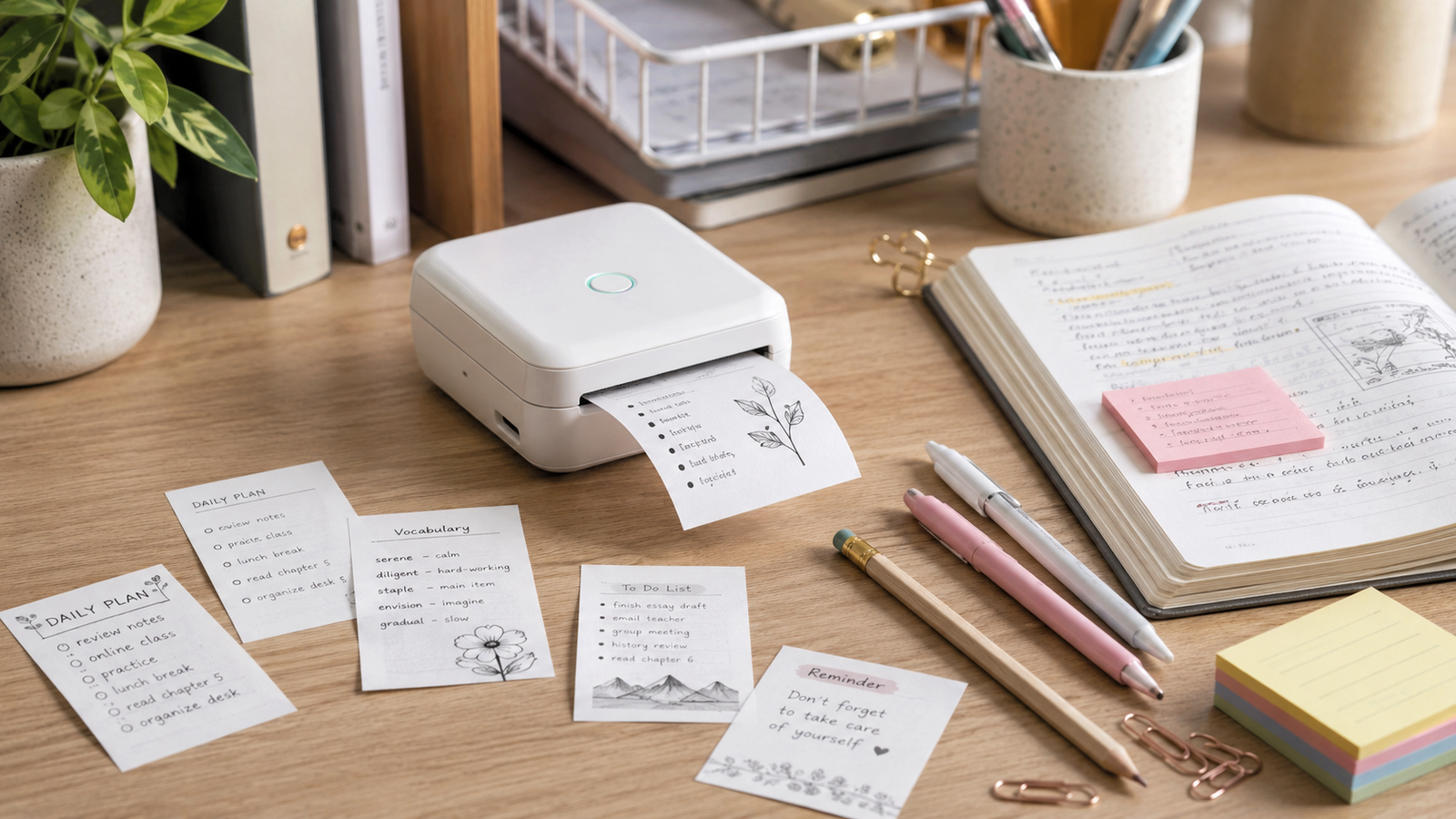
They are compact enough to carry in a school bag, pencil pouch or handbag, connect wirelessly to a smartphone, and print small notes, labels, lists, stickers and simple images without traditional ink cartridges.
For children, they can turn study notes and craft projects into something more interactive. For students, they can be handy for revision labels, reminders and quick organisational tasks. And for journal lovers, they offer an easy way to add printed quotes, headings, checklists and decorative elements to notebooks and planners.
The biggest attraction is simple: you can print almost anywhere without worrying about ink.
Affiliate Disclosure: This article may contain affiliate links. If you purchase through one of these links, we may earn a commission at no additional cost to you. As an Amazon Associate, we earn from qualifying purchases.
What Is a Mini Thermal Printer?
A mini thermal printer is a small printer that uses heat-sensitive thermal paper rather than conventional ink or toner.
Most portable models are designed to connect to a smartphone through Bluetooth and work with a companion app. You choose or create what you want to print in the app, send it to the printer, and the device produces a small black-and-white printout.
Their main advantage is convenience.
There are no ink cartridges to replace, and the printers themselves are generally small enough for portable use.
However, they are not substitutes for normal home printers. They are better suited to labels, notes, lists, small graphics, journaling and creative projects than full-size documents or high-quality photographs.
Why Mini Thermal Printers Are Becoming So Appealing
1. No Ink Cartridges
The most obvious benefit is ink-free operation.
Instead of using ink, thermal printers create images by applying heat to special thermal paper.
That removes one of the frustrations associated with conventional printers: buying and replacing cartridges.
You will still need to purchase compatible thermal paper, so the printer is not completely free to operate.
2. Small Enough to Carry Around
Portability is one of the category's biggest strengths.
A mini thermal printer can be useful at a study desk, in a classroom, while travelling or beside a journal without taking up much space.
For people living in smaller homes or working at compact desks, this can make them much easier to accommodate than a conventional printer.
3. Bluetooth Printing From a Phone
Many mini thermal printers are designed around smartphone use.
Rather than transferring files to a computer, users can prepare notes, labels, lists or simple designs in the printer's mobile app and print wirelessly.
For younger users in particular, this can make the printing process feel far more approachable.
4. They Make Organisation More Enjoyable
Mini thermal printers are not essential productivity tools, but they can make ordinary organisational tasks more engaging.
You could use one to print:
- revision labels
- vocabulary words
- study reminders
- to-do lists
- habit trackers
- journal headings
- shopping lists
- storage labels
- motivational quotes
- simple illustrations
That mixture of creativity and practicality is a major part of their appeal.
Why Children May Enjoy a Mini Thermal Printer
For children, the attraction is less about conventional printing and more about creating something physical.
They can design a small note on a phone, print it and immediately stick or paste it into a notebook or project.
Possible uses include:
Homework organisation
Children can print reminders, subject labels or short revision notes.
Creative projects
Small printed graphics and text can become part of scrapbooks, cards and craft activities.
Vocabulary practice
Parents can create small word labels for spelling, language learning or revision.
Reward charts
Parents may also use printed labels, stars or short messages as part of simple home reward systems.
Parents should still check the manufacturer's recommended age guidance and supervise younger children where appropriate.
Why Students May Find Them Useful
Students are probably one of the strongest audiences for mini thermal printers.
A small printer can be useful for creating quick study materials without setting up a full-size printer.
Revision Notes
Important definitions, formulas or quotations can be printed and attached to notebooks.
Flashcard Labels
Students can create short prompts or answers and attach them to revision cards.
Planner Organisation
Deadlines, exam dates and task lists can be printed for planners and calendars.
Notebook Headings
Instead of writing every heading by hand, students can create neat printed titles or labels.
For serious academic printing, however, a normal A4 printer remains the better choice.
A mini thermal printer should be viewed as a study accessory rather than a replacement for a home printer.
Why Journal Lovers Will Probably Have the Most Fun
Journaling is where these printers arguably make the most sense.
People who enjoy planners, scrapbooks, travel journals or bullet journals can use mini printers to add visual elements without owning a photo printer or repeatedly handwriting decorative text.
Ideas include:
- quotes
- dates
- mini calendars
- habit trackers
- headers
- checklists
- mood trackers
- captions
- simple illustrations
- decorative labels
Because many thermal printers produce monochrome prints, the result can work particularly well with minimalist or vintage-style journals.
The Main Advantages
Ink-Free Operation
No cartridges or toner are required.
Portable Size
Easy to store or carry compared with a conventional printer.
Quick Smartphone Printing
Bluetooth connectivity makes small print jobs convenient.
Good for Creative Projects
Useful for journals, crafts, planners and labels.
Simple Everyday Organisation
Can turn reminders, lists and labels into physical notes within seconds.
The Limitations You Should Know Before Buying
Mini thermal printers are fun, but they are not suitable for every buyer.
Prints Are Usually Small
These devices are intended for compact printouts, not full-size documents.
Most Are Monochrome
Buyers wanting colourful photographs or detailed artwork should look at portable photo printers instead.
Thermal Paper Is a Running Cost
You do not buy ink, but you do need compatible thermal paper.
Thermal Prints Can Fade
Thermal paper is sensitive to heat, light and storage conditions, so it is not ideal when you need documents to remain unchanged for many years.
App Quality Matters
Because the mobile app is central to the experience, an otherwise attractive printer can become frustrating if its software is difficult to use.
This is an important point to check before buying.
What to Look for When Buying a Mini Thermal Printer
1. Paper Size
Check the supported paper width before purchasing.
A slightly wider printer can be more useful for study notes and journaling, while very narrow models are better suited to labels and short messages.
2. Replacement Paper Availability
Do not evaluate the printer alone.
Check whether compatible thermal paper is easy to buy and reasonably priced.
A cheap printer can become inconvenient if replacement rolls are difficult to find.
3. Bluetooth Compatibility
Confirm that the printer supports your phone's operating system.
4. App Features
Look for an app that allows you to create useful content such as:
- text
- labels
- lists
- templates
- simple graphics
- images
- QR codes, where supported
The exact features vary by model.
5. Battery and Charging
If portability is important, check the listed battery specifications and charging method.
6. Print Resolution
Higher resolution can make text and simple illustrations look cleaner, although it should not be confused with photographic print quality.
7. Size and Weight
If the printer is mainly for travel, school or carrying in a bag, compact dimensions matter more than they would for a printer that stays permanently on a desk.
8. Paper Type
Some printers support adhesive-backed thermal paper as well as ordinary rolls.
Sticker-style paper can be especially useful for journaling, labelling and children's projects.
Always verify compatibility with the specific printer before purchasing paper.
Who Should Buy a Mini Thermal Printer?
A mini thermal printer makes the most sense for someone who enjoys creating lots of small printed items.
It is particularly worth considering for:
- students who enjoy organised notes
- children who like craft activities
- bullet-journal enthusiasts
- scrapbookers
- planner users
- parents creating labels and learning activities
- travellers keeping journals
- people who enjoy small stationery gadgets
Who Should Skip One?
Consider another type of printer if you primarily need:
- school worksheets
- office documents
- A4 printing
- colour photographs
- long-lasting archival prints
- high-volume printing
In those cases, a conventional inkjet, ink-tank, laser or dedicated photo printer will usually be more appropriate.
Are Mini Thermal Printers Worth Buying?
For the right person, yes.
Their strongest advantage is not that they replace a normal printer. They do not.
Their appeal comes from making small-scale printing quick, portable and enjoyable.
Children may enjoy turning ideas into physical stickers and notes. Students can create quick revision aids. Journal lovers can add printed elements to notebooks without spending time drawing or handwriting everything.
For someone who regularly uses planners, labels, scrapbooks or study notes, a mini thermal printer can become a genuinely useful little gadget.
For someone who simply wants to print documents, however, it is probably the wrong product category.
Our Verdict
★★★★☆
Mini thermal printers combine three appealing qualities: they are portable, easy to use and do not require conventional ink cartridges.
Their limitations are equally important to understand. Printouts are small, usually monochrome and dependent on thermal paper, so these devices should not be viewed as substitutes for full-size printers.
But for their intended audience — children, students, journal lovers and stationery enthusiasts — they can be both practical and genuinely fun to use.
Best for: Journaling, study notes, labels, crafts and lightweight organisation.
Consider another option if: You need A4 documents, colour printing or permanent photo-quality prints.
CTA: Check Current Mini Thermal Printer Options on Amazon →
Frequently Asked Questions
Do mini thermal printers need ink?
No. Thermal printers create prints using heat-sensitive thermal paper rather than conventional ink cartridges or toner.
Can students use a mini thermal printer for study notes?
Yes. They can be useful for short revision notes, labels, vocabulary, formulas, headings and planner reminders. They are not designed to replace an A4 printer.
Are mini thermal printers good for children?
They can be appealing for craft projects, learning activities and labels. Parents should check the manufacturer's age recommendations and supervise younger children when necessary.
Can mini thermal printers print photos?
Some models can reproduce images, but typical mini thermal printers produce small monochrome thermal prints rather than conventional colour photographs.
Do thermal printer images last forever?
No. Thermal paper can gradually fade and may be affected by heat, light and storage conditions.
What can I print with a mini thermal printer?
Depending on the printer and its app, common uses include notes, labels, lists, journal decorations, revision prompts, simple graphics and organisational reminders.
Is a mini thermal printer worth buying for journaling?
It can be a particularly good fit for journaling because it makes it easy to add headings, quotes, checklists, labels and small decorative elements without using ink.